






India’s New Space Race
For decades, Indian space exploration was synonymous with the Indian Space Research Organisation (ISRO). But a monumental shift is underway. The government's decision in 2020 to open the sector to private players has ignited a vibrant startup ecosystem,
with over 400 space-tech companies now in the fray. This policy change aims to grow India's share of the global space economy from 2% to a projected 8-10% by 2033, potentially creating a market worth over $40 billion. Companies like Hyderabad-based Skyroot Aerospace are leading this charge, not just by building rockets, but by creating a powerful new engine for economic growth and technological self-reliance.
Skyroot and the Vikram-1 Mission
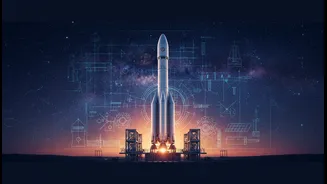
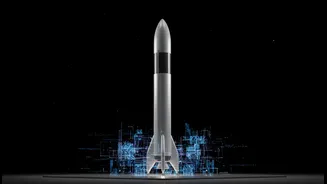
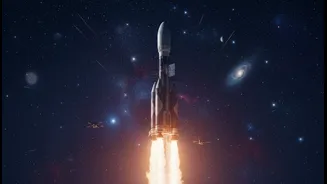
Founded in 2018 by former ISRO engineers Pawan Kumar Chandana and Naga Bharath Daka, Skyroot Aerospace has quickly become a poster child for India's private space ambitions. The company made history in 2022 with Vikram-S, the nation's first privately developed rocket to reach space. Now, it is on the cusp of an even greater milestone: the launch of Vikram-1. Scheduled for July 18, 2026, the mission, named 'Aagaman' (Arrival), will be India's first private attempt to place satellites into orbit. This seven-storey-tall rocket is designed to carry small satellites into Low Earth Orbit, featuring cutting-edge technologies like an all-carbon composite structure and 3D-printed engines. A successful launch would validate Skyroot's technology and signal India's arrival as a key player in the global commercial launch market.
The Mechanical Engineering Backbone
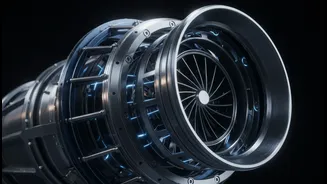
A rocket like Vikram-1 is a marvel of complex, interacting systems, and at the heart of making it all physically work are mechanical engineers. Their role is far from monolithic; it spans nearly every aspect of the vehicle's creation. They are the architects of the rocket's physical form, responsible for structural design and analysis. They ensure the frame is both lightweight enough to escape gravity and strong enough to withstand the violent vibrations and immense forces of launch. They delve into thermodynamics and fluid dynamics to design the propulsion systems, figuring out how to manage super-cooled cryogenic fuels and control the immense energy of a rocket engine. Every nozzle, valve, and fuel line passes through their hands. From the mechanisms that deploy satellites in orbit to the thermal systems that protect the vehicle from the extreme heat and cold of space, mechanical engineering is the discipline that turns theoretical physics into a functional, flying machine.
From Theory to Thrust
Skyroot has actively built its team by tapping into the immense talent pool of India’s engineering colleges. The company's job postings and fellowship programs frequently target fresh graduates and final-year students in mechanical, aerospace, and related fields. Initiatives like the Kalpana Fellowship, exclusively for women, are designed to bring young, passionate engineers directly into the fold. For these graduates, it's a chance to apply classroom knowledge on a national stage. Concepts like finite element analysis, computational fluid dynamics, and material science are no longer just textbook chapters; they are the tools used to design and test components for Vikram-1. This infusion of young talent creates a dynamic, innovative environment where graduates are given significant responsibility, contributing directly to designing, building, and testing the hardware that will fly to orbit.
A Launchpad for a Generation
The success of companies like Skyroot is creating more than just rockets; it's building a new, aspirational career path for hundreds of thousands of Indian engineering students. For generations, top graduates might have looked to IT or sought opportunities abroad. Now, the space-tech boom offers a chance to work on cutting-edge, nation-building projects at home. This shift is having a ripple effect, inspiring students and encouraging universities to tailor programs to meet the industry's demands. The Vikram-1 mission is, therefore, more than a single launch. It represents a launchpad for the careers of countless young Indians who are quite literally reaching for the stars, powered by their own ingenuity and the burgeoning opportunities in their home country.