





What is the 'Tower-Catch' Method?
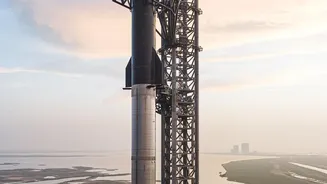
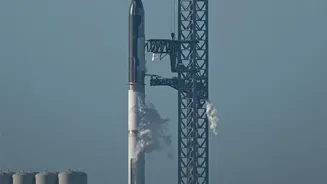
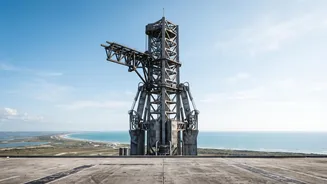
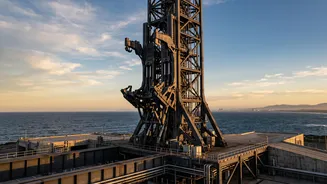
Imagine a 400-foot-tall building with two giant, movable arms—nicknamed 'chopsticks'—that can shift up, down, and sideways. Now, imagine a 23-story rocket booster, called Super Heavy, descending from the edge of space, firing its engines to slow itself
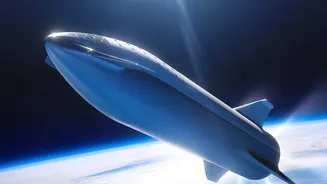
down, and positioning itself perfectly between these arms. In the final moments, the arms close, clamp onto the booster, and lift it back onto the launch mount. This is the essence of the tower-catch system, officially part of the Orbital Launch Mount. It’s a ground system designed to not only support a launch but to actively participate in the rocket's recovery. This system, which has successfully caught a booster, is also being prepared to one day catch the Starship upper stage as well.
The Mechanics of a 'Perfect Catch'
The maneuver demands almost unbelievable precision. After separating from the Starship upper stage, the Super Heavy booster flips around and performs a 'boostback burn' to fly back to the launch site. Using its four large grid fins for steering, it navigates through the atmosphere. As it nears the tower, a final landing burn is meant to bring its velocity to nearly zero at the exact right altitude and position. The whole process is automated, relying on a suite of high-resolution cameras, LiDAR sensors, and advanced control algorithms to make real-time adjustments. The arms themselves are powered by massive hydraulic systems designed to absorb the immense energy of the returning booster without damaging it or the tower.
Why Not Just Use Landing Legs?
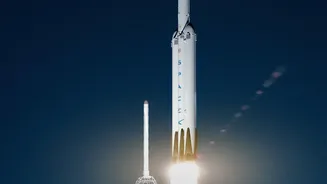
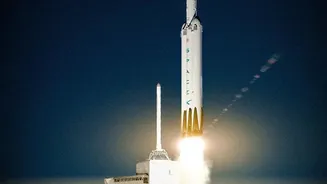
SpaceX’s own Falcon 9 rocket has successfully used landing legs for years, so why the change? The answer lies in mass and speed. Landing legs, and the structure needed to support them, are heavy. By removing them from the Super Heavy booster, SpaceX makes the rocket lighter, allowing it to carry more fuel or heavier payloads. The hardware for landing is moved to the ground, where mass isn't a penalty. More importantly, the catch method is designed for rapid reusability. A booster caught by the tower is already at the launch site, ready for inspection, refueling, and integration for its next flight. There's no need for a lengthy recovery process from a droneship or a remote landing pad, which is necessary for the Falcon 9.
The Ultimate Goal: Rapid, Full Reusability
The tower catch is the key that unlocks SpaceX’s entire business model for Starship. The goal is not just reusability, but full and rapid reusability, similar to an aircraft. By catching and relaunching both the Super Heavy booster and the Starship upper stage, SpaceX aims to slash the cost of getting to orbit by 99%. Instead of building a new rocket for every mission, the primary cost becomes the propellant. This would enable a launch cadence previously unheard of, with the potential for multiple flights of the same vehicle in a single day. Such frequency is necessary for ambitious projects like deploying the next generation of Starlink satellites and, most famously, building a self-sustaining city on Mars.
Incredible Risk, Incredible Reward
The challenges are immense. The system has to work perfectly, with the booster arriving at the right spot, at the right speed, and in the right orientation. A failure could be catastrophic, potentially destroying both the multi-billion dollar rocket and the launch tower itself. The returning booster's engines create an extreme heat and acoustic environment for the tower and its arms. The entire catch sequence must be fully autonomous, as human reaction times are far too slow to manage the final seconds. Despite the risks, SpaceX has already successfully caught a Super Heavy booster on its fifth flight test in October 2024, proving the concept is viable. The company is now working towards catching the Starship upper stage, which would mark the first time an orbital-class rocket has been fully recovered.