

Seeing the Universe's Baby Pictures
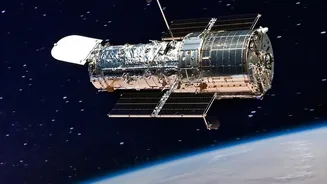
The most powerful tool in this exploration is the James Webb Space Telescope (JWST). Its ability to see in infrared light allows it to peer through cosmic dust and capture light that has travelled for over 13 billion years. This is like looking at a photo
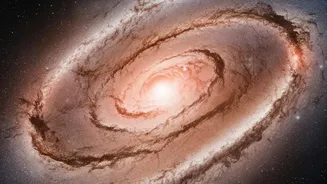
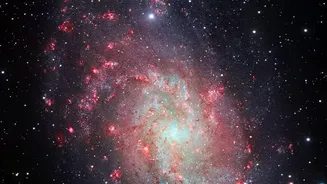
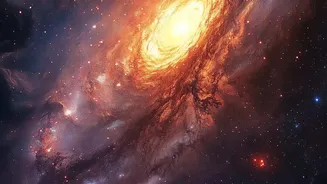
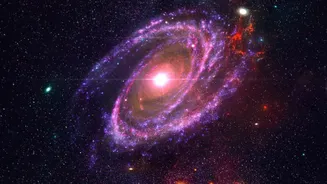
album of the universe's infancy. What astronomers are finding is genuinely shocking: the infant universe was far from primitive. Recent discoveries have confirmed galaxies that existed when the cosmos was just a few hundred million years old. Before JWST, models predicted these early galaxies would be small, simple, and isolated. Instead, we are seeing objects that are surprisingly bright, massive, and complex.
Rewriting the Rules of Galaxy Growth
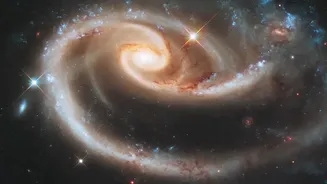
The standard model of cosmology suggested that galaxies grew slowly over billions of years, gradually merging and accumulating mass. The latest images throw a wrench in that theory. Astronomers have found evidence of massive, multi-galaxy mergers happening much earlier than expected. One recent discovery found a tightly packed collision of at least five galaxies from an era when such complex interactions were thought to be rare. We are also seeing galaxies that appear surprisingly mature. One massive galaxy, spotted when the universe was less than two billion years old, shows no sign of rotation—a trait normally seen in much older, more evolved galaxies that have undergone many mergers. This suggests the processes that shape galaxies into their modern forms happened much faster than we thought.
A Chemical Fingerprint of the First Stars
These images are not just pictures; they are rich data sets. Using a technique called spectroscopy, scientists can analyse the light from these ancient galaxies to determine their chemical makeup. The early universe contained only the lightest elements, like hydrogen and helium. Heavier elements, which astronomers call 'metals', are forged inside stars and spread through space when they die. JWST has detected heavy elements like oxygen and even complex carbon-based molecules in the halos of very early galaxies. This tells us that the first generations of stars must have formed, lived, and died very quickly to have seeded the universe with these materials so early in its history. Some galaxies appear to contain nitrogen, an element that takes even longer to produce, posing a further puzzle for astronomers.
The Mystery of the 'Little Red Dots'
Among the most intriguing new discoveries are objects nicknamed 'Little Red Dots'. These are extremely distant, compact objects that appear reddish in JWST's infrared view. Since 2024, hundreds have been found, and astronomers are working to understand what they are. The leading theories are just as exciting as the mystery itself. One idea is that they are the bright, active hearts of primordial galaxies, powered by supermassive black holes. If true, this raises a major question: how did black holes grow to be so massive, so quickly, in the early universe? Another theory is that they could be a type of supermassive star, a theoretical object that has never been directly observed. Whatever they turn out to be, these little dots are a completely new class of object that will help redefine our understanding of the cosmic dawn.