



The Ultimate Cosmic Speed Limit
Everything we see is thanks to light. But light, while incredibly fast, is not instantaneous. It travels at a fixed, universal speed limit of approximately 3,00,000 kilometres per second. That’s fast enough to circle the Earth more than seven times in a single
second. On our human scale, this seems immediate. The light from a lamp across the room reaches your eyes so quickly that the delay is utterly imperceptible. But the universe operates on a scale that dwarfs our everyday experience. When distances stretch into millions and billions of kilometres, even this incredible speed starts to look sluggish. The vast emptiness of space means that light from celestial objects must undertake immense journeys to reach our eyes on Earth.
Understanding the Light-Year
Because the distances are so enormous, astronomers don't use kilometres. Instead, they use a unit called a 'light-year'. This isn't a measure of time, but of distance. One light-year is the distance light travels in one year, which comes out to a staggering 9.5 trillion kilometres. Think of it this way: if a star is one light-year away, the light you see from it tonight actually left that star one year ago. You are seeing the star as it existed back then. This simple fact transforms stargazing from a simple act of observation into an act of cosmic time travel. The night sky is not a static snapshot of the present; it's a layered collage of different moments in history, all arriving at your eye at the same time.
Your Sky Is a History Book
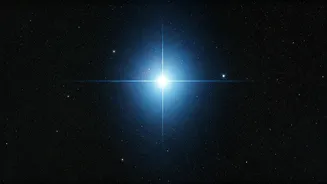
Let’s put this into practice with some familiar stars you might see from India. Sirius, the brightest star in our night sky (known as 'Vyadha' in Indian astronomy), is about 8.6 light-years away. The light hitting your eye tonight left Sirius in late 2015. When you see it, you're seeing light that started its journey when the world was a very different place. Now consider a more dramatic example: Betelgeuse ('Thiruvathirai' or 'Ardra'), the prominent reddish star in the Orion constellation. It is roughly 640 light-years away. The light we see from it tonight began its journey around the year 1384, during the time of the Tughlaq dynasty in the Delhi Sultanate. You are witnessing a star as it was centuries before the Mughal Empire was even founded. Every star tells a similar story, some from years ago, others from millennia.
Looking Back to the Dawn of Time
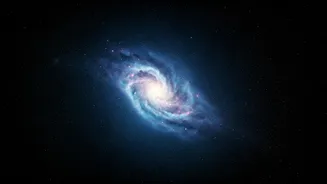
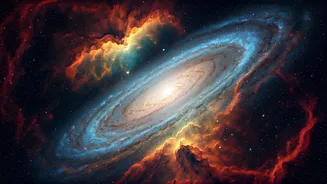
This principle is the foundation of modern astronomy. The farther we look into space, the further back in time we are peering. The Andromeda Galaxy, the closest major galaxy to our own Milky Way and faintly visible to the naked eye in very dark skies, is 2.5 million light-years away. We are seeing it as it was when early human ancestors were first walking the Earth. Powerful instruments like the Hubble and James Webb Space Telescopes are designed to push this limit even further. They are cosmic time machines, capturing light from the very first galaxies that formed over 13 billion years ago, giving us a direct window into the infancy of the universe itself. What they capture isn't just a picture; it's an echo of the cosmos's birth.