






The Dark, Cold, and Critical Frontier
Covering over two-thirds of our planet, the deep sea is a realm of immense pressure, freezing temperatures, and near-total darkness. For centuries, it was largely a mystery, a blank space on the map. Yet, this vast, unseen habitat is not empty; it plays
a critical role in regulating our planet's climate, recycling nutrients, and supporting global biodiversity. The ocean absorbs vast amounts of heat and human-produced carbon dioxide, acting as a crucial buffer against climate change. Understanding these deep processes is no longer just a matter of scientific curiosity; it's essential for managing fisheries, assessing climate risks, and protecting unique ecosystems before they are lost forever.
A New Generation of Eyes in the Deep
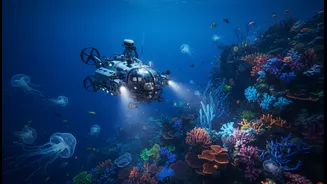
The challenge of studying the deep ocean has always been technological. Sending humans or even tethered vehicles into these hostile environments is difficult and expensive. But a new suite of tools is changing the game entirely. Autonomous Underwater Vehicles (AUVs) are at the forefront of this transformation. These untethered robotic submarines can be pre-programmed to carry out complex missions, mapping the seafloor or collecting data over vast areas for extended periods. They are often equipped with an array of advanced sensors to measure temperature, salinity, and chemical composition of the water. Another key innovation is the use of environmental DNA (eDNA), where scientists analyze genetic material left behind by organisms in water samples. This non-invasive technique allows researchers to detect the presence of species, from tiny microbes to large whales, without ever seeing them.
From Snapshots to a Live Stream
Perhaps the biggest shift is the move from expedition-based science to continuous monitoring. Previously, deep-sea research relied on sending ships out to specific locations to collect samples—a process that provided only a brief snapshot in time. Today, networks of cabled observatories, moored buoys, and free-drifting floats provide a constant flow of information. The Ocean Observatories Initiative (OOI), for example, is a network of over 900 sensors delivering real-time data on ocean conditions. This persistent presence allows scientists to observe dynamic events as they unfold, such as marine heatwaves, underwater volcanic activity, or the seasonal cycles of deep-sea life. This shift is like going from having a few old photographs of a place to watching a continuous, high-definition live stream. The sheer volume and consistency of the data are revolutionary.
The Power of AI in Ocean Discovery
The flood of data from these new tools presents its own challenge: how to make sense of it all. This is where Artificial Intelligence (AI) and machine learning are proving indispensable. AI algorithms can process immense datasets far faster than humans, identifying patterns, anomalies, and insights that might otherwise be missed. For instance, AI is being used to analyze the billions of genetic sequences generated by eDNA surveys, helping to identify known species and even flag potentially new ones. In the world of AUVs, AI enhances their autonomy, allowing them to make decisions and adapt their missions in real-time based on the data they collect, like navigating around unexpected obstacles or investigating a surprising chemical reading. This synergy between advanced sensors and intelligent analysis is accelerating the pace of discovery.
Why This Exploration is So Timely
The expansion of deep-sea science is happening at a critical moment. Our oceans are undergoing rapid change, and the long-term data from these monitoring systems are vital for understanding and predicting the impacts. The information is used to track changes in major ocean currents, monitor the spread of ocean acidification, and understand how ecosystems are responding to warming waters. This knowledge is crucial not just for scientists but for policymakers, coastal communities, and industries like fishing that depend on a healthy ocean. The story took on a new urgency in mid-2026, when plans to dismantle the critical Ocean Observatories Initiative were reversed after a bipartisan outcry from lawmakers and scientists, highlighting a growing recognition of the network's importance for national security and climate preparedness.