


The Challenge of Finding Faint Objects
Spotting an asteroid isn't easy. These are not glittering giants; most are small, dark, and incredibly far away. A dim asteroid might be only a few hundred metres across and made of rock that reflects very little sunlight. Trying to find one against the
vast, dark backdrop of space is like searching for a piece of coal in a dark room from miles away. Ground-based optical telescopes face the additional challenge of Earth's atmosphere, which can distort light. This is why detecting these faint objects requires powerful technology and clever techniques. It is a critical task managed by organisations like NASA's Planetary Defense Coordination Office (PDCO), which is responsible for the early detection of these near-Earth objects (NEOs).
A Digital Eye on the Night Sky
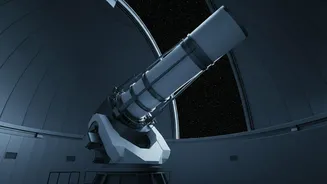
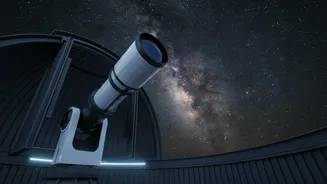
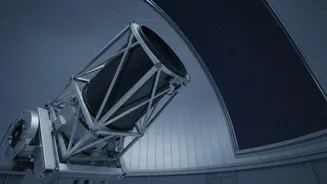
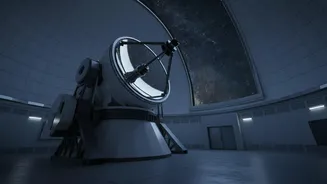
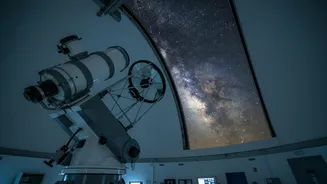
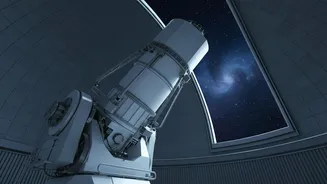
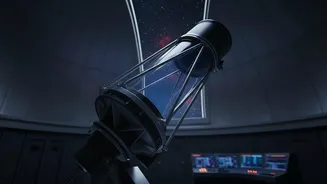
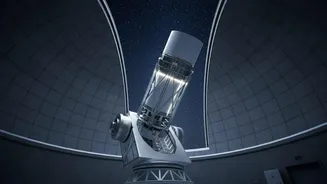
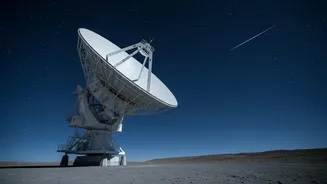
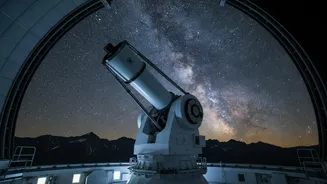
Modern asteroid hunting relies on advanced optical telescopes that act like giant digital cameras. Surveys such as the Catalina Sky Survey and Pan-STARRS use telescopes with wide fields of view to photograph large patches of the night sky repeatedly. Instead of looking for a single moving object in real-time, these telescopes take a series of images of the same area, typically minutes or hours apart. Each image captures a snapshot of the stars, which remain fixed, and any other object that might be moving through the frame. The soon-to-be-operational Vera C. Rubin Observatory in Chile will take this to the next level, using a massive 3,200-megapixel camera to survey the entire southern sky every few days, generating 20 terabytes of data each night.
Software That Connects the Dots
The real magic happens in the data processing. With thousands of stars in every image, finding a single moving dot is impossible for the human eye. Instead, sophisticated computer algorithms compare the series of images. The software digitally subtracts one image from the next, causing the stationary stars to disappear. Anything that has moved between exposures will appear as a leftover point of light. Next-generation algorithms like HelioLinc3D are being developed to identify asteroids even with fewer observations than previously required. This allows systems like the Rubin Observatory to scan the sky more quickly, covering more ground and increasing the chances of spotting a new object.
Calculating the Path to Safety
Detecting a point of light is just the first step. To determine if it's a threat, astronomers need to calculate its orbit. This requires multiple observations over several nights, and sometimes weeks. Each new position helps refine the object's trajectory around the Sun. Organisations like the Center for Near-Earth Object Studies (CNEOS) at NASA's Jet Propulsion Laboratory use this data to compute high-precision orbital paths. They can then project the asteroid's path far into the future to see how close it will come to Earth. An object is generally considered a "potentially hazardous asteroid" if its orbit brings it within about 7.5 million kilometres of Earth's path and it is larger than about 140 meters. Most NEOs pass by at much greater, perfectly safe distances.
A Global Network of Sentinels
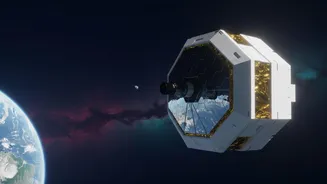
Planetary defense is a global effort. Data from surveys around the world is sent to the Minor Planet Center (MPC), an international clearinghouse for all asteroid and comet observations. This collaborative network includes ground-based telescopes and will soon be enhanced by space-based observatories like NASA's NEO Surveyor. This infrared space telescope is specifically designed to find asteroids that are difficult for ground telescopes to see, such as dark objects or those approaching from the direction of the Sun. This coordinated system ensures that once an object is detected, it is tracked by astronomers worldwide, creating a robust safety net for the planet.