




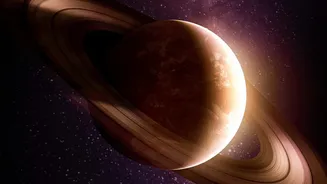
A New Polygon on the Ringed Planet
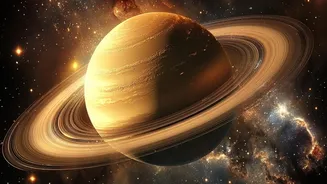
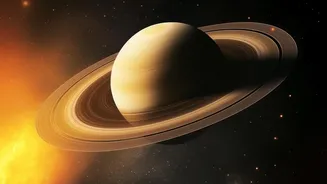
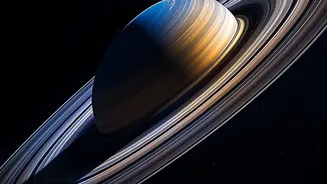
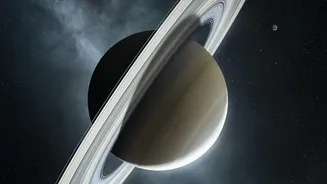
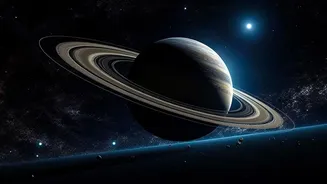
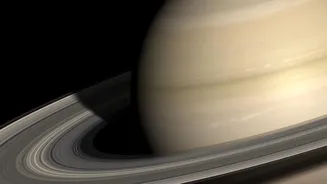
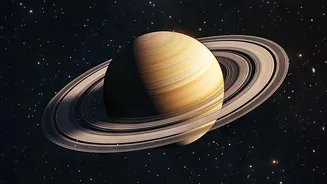
In a discovery that challenges our understanding of planetary atmospheres, astronomers have confirmed the existence of a massive, 10-sided geometric pattern encircling Saturn’s south pole. Announced in early September 2026, this feature is described as an atmospheric
wave within one of the planet's powerful jet streams. The discovery was made by an international team of scientists using data from the Hubble Space Telescope’s Outer Planet Atmospheres Legacy (OPAL) program, which conducts long-term monitoring of our solar system’s gas giants. Unlike a solid structure, this decagon is a persistent pattern in the clouds, a colossal storm system with ten distinct sides. What makes this finding particularly thrilling is that it appears to be a recent development, offering scientists a rare, real-time glimpse into the formation of one of these giant planetary phenomena.
Saturn's Famous Northern Hexagon
To appreciate the significance of this new decagon, it helps to look at its famous northern counterpart. For over 40 years, scientists have been captivated by a bizarre hexagon at Saturn's north pole. First spotted by the Voyager spacecraft in the early 1980s, this six-sided jet stream is enormous, with each side longer than the diameter of Earth. It has remained remarkably stable and locked in place, a permanent fixture every time we have looked. The hexagon has been a subject of intense study and even recreated in laboratory experiments, yet its precise formation mechanism and longevity on Saturn remain debated. For a long time, it was considered a unique, one-off feature, as extensive searches of the south pole—most notably by the Cassini spacecraft—showed no similar structure.
A Tale of Two Poles
The new southern decagon is not just a copy of the northern hexagon. The differences between them are what make the discovery so compelling. While the hexagon is ancient and stable, the decagon is new and dynamic. Data shows it was not present during the Cassini mission, which orbited Saturn from 2004 to 2017. This proves the decagon formed sometime after 2017. Archival images from Hubble trace its emergence, showing faint hints in 2023 that grew into a more defined 10-sided shape by 2025. It also appears to be strengthening and drifting, unlike the stationary northern hexagon. This contrast suggests that while polygonal storms might be a natural feature of Saturn's atmospheric physics, they can form, evolve, and perhaps disappear on timescales humans can observe.
How Astronomers Spotted It
The discovery was a masterclass in modern astronomical collaboration. The south pole of Saturn only recently tilted back towards Earth's view after years of being hidden due to the planet's long, 29-year orbit. The first clues came not from NASA, but from ground-based observatories and amateur astronomers who noticed an odd, undulating pattern in images from 2024. This prompted a closer look with the Hubble Space Telescope. Its position above Earth's blurring atmosphere allowed it to capture crystal-clear, high-resolution images that confirmed the 10-sided shape. The find underscores the vital role of continuous observation. Without Hubble's consistent monitoring and the watchful eyes of sky-gazers around the world, this fledgling phenomenon could have been missed.
The Mysteries That Remain
This newborn decagon presents a host of tantalizing questions for planetary scientists. Chief among them: Why now? What atmospheric trigger caused this massive pattern to form so suddenly? One theory suggests a link to a large, nearby anticyclonic vortex that may have provided the initial disturbance needed to sculpt the jet stream into a wave. Scientists are now eager to see if the decagon will stabilize and persist for decades like the hexagon, or if it's a more transient weather event. Future observations with both Hubble and the James Webb Space Telescope will be crucial for studying its vertical structure and thermal properties. For now, astronomers are simply thrilled to have a front-row seat to watch a giant atmospheric pattern develop on another world.