





A World of Crushing Weight
The deepest parts of the ocean, like the Mariana Trench, are subject to hydrostatic pressures over 1,100 times greater than what we experience at sea level. This is equivalent to the weight of 50 jumbo jets stacked on top of a single person. For life
as we know it, this pressure is devastating. It compacts cell membranes, causing them to solidify like butter in a refrigerator, and it can bend and warp the delicate three-dimensional structures of proteins, preventing vital biochemical processes from occurring. Any air-filled spaces, like the lungs in our bodies or the swim bladders in many shallow-water fish, would collapse instantly under such force. The fundamental challenge for deep-sea life is not just to exist, but to perform the complex functions of life in an environment that actively works to crush it.
The Piezolyte Solution
One of the most crucial adaptations is found at the molecular level. Deep-sea organisms have evolved to accumulate high concentrations of small organic molecules called 'piezolytes', a term derived from the Greek word for pressure. The most famous of these is trimethylamine N-oxide, or TMAO. This compound, which gives fish their characteristic 'fishy' smell, acts as a protein stabilizer. Under intense pressure, water molecules inside cells can become distorted, which in turn disrupts protein function. TMAO counteracts this by strengthening the hydrogen bonds in the surrounding water, creating a stable structure that shields proteins and enzymes, allowing them to maintain their proper shape and function. Studies have shown a direct correlation: the deeper an organism lives, the more TMAO it tends to have in its cells.
Soft Bodies and Flexible Skeletons
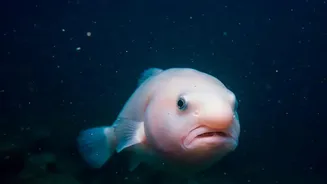
Physical structure is just as important as molecular chemistry. Rather than fighting the pressure with rigid strength, deep-sea creatures yield to it. Many, like the famous blobfish or the Mariana snailfish, have gelatinous, squishy bodies that are primarily composed of water. Since water is virtually incompressible, the pressure inside their bodies naturally equalizes with the immense pressure outside, preventing them from being crushed. They have also done away with rigid, calcified skeletons that would crack under the strain. Instead, their skeletal structures are made mostly of cartilage, which is far more flexible and can bend without breaking. Furthermore, most deep-sea organisms have completely eliminated internal air pockets. Instead of gas-filled swim bladders for buoyancy, they often rely on fatty livers or their low-density, gooey tissues to keep from sinking.
Evolution Forged in the Deep
These incredible traits are the result of millions of years of evolution in one of Earth’s most extreme environments. The ancestors of today's deep-sea life gradually adapted as they moved into deeper waters. Organisms with genetic variations that offered even a slight advantage—a more stable protein, a more flexible cell membrane, or a slightly less dense body—were more likely to survive and reproduce. Over countless generations, these traits became dominant. For instance, the Mariana snailfish, the deepest-known fish, has evolved to thrive where others perish. Genetic analysis shows it has multiple copies of genes related to withstanding pressure and has lost genes related to vision, which are useless in the perpetual darkness of the hadal zone. They move slowly, conserving energy in a food-scarce environment, and are top predators in their niche, perfectly equipped for life in the abyss.