






The Case of the Vanishing Planet
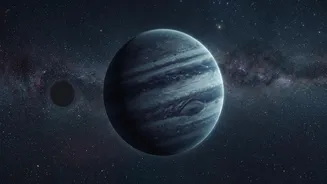
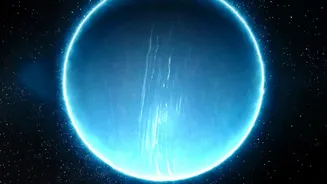
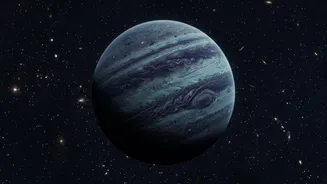
For seven years, astronomers had a routine appointment with TOI-2535 b. Using NASA's Transiting Exoplanet Survey Satellite (TESS), they watched this distant world, a 'hot Jupiter' about the size of our own Jupiter, as it passed in front of its star. This
'transit' method, where a planet causes a tiny, regular dip in a star's light, is how thousands of exoplanets have been found. But with TOI-2535 b, the routine became anything but. First, its timing was off. The planet would arrive for its transit up to six hours early or late, a massive deviation. Then, the transits themselves became shorter and shallower. And then, in early 2026, they stopped altogether. The planet seemingly vanished into thin air.
A Gravitational Ghost in the Machine
Planets don't just get destroyed or fly off into space without a trace. Astronomers knew the planet was still there, but something had changed. The only force powerful enough to alter a planet's orbit so dramatically is gravity. The culprit, they concluded, had to be an unseen neighbour: another large planet in the same system, pulling on TOI-2535 b. Think of two spinning tops near each other. As they spin, they also wobble, and their gravitational interaction causes both of their orbits to slowly precess, or wobble, over time. The orbit of TOI-2535 b was tilted by this gravitational tug until, from our perspective on Earth, it no longer crossed the face of its star. The planet didn't disappear; our perfect viewing angle did.
Meet the Suspect: An Invisible Giant
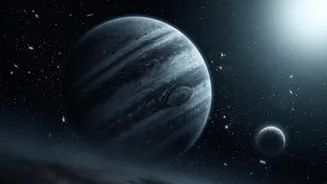
Scientists haven't seen this disruptive neighbour directly, because its orbit is also tilted and doesn't appear to transit the star. But by modelling the strange behaviour of TOI-2535 b, they have a profile of the suspect. The evidence points to a planet with a mass of at least Saturn, or possibly larger. This hidden world is also in a relatively close, tilted orbit, and the two giant planets are likely locked in what is called a mean-motion resonance, meaning their orbital periods are related by a ratio of two small integers. This constant, rhythmic pulling and pushing between them is what's driving the rapid orbital changes, the fastest such change ever observed for a planet around a single star.
Why This Cosmic Mystery Matters
The discovery is more than just a curiosity; it's a major clue in the puzzle of how planetary systems form. 'Hot Jupiters' like TOI-2535 b are a long-standing enigma because they are too large to have formed so close to their star. The leading theory is that they form farther out and migrate inward. This case supports a less violent, slow-migration theory. A catastrophic event, like a near-collision, would have likely flung one of the planets out of the system. The fact that two giant planets exist in a relatively stable, though wobbly, configuration suggests they spiraled inward together within the disk of gas and dust that formed them. It shows that even planetary systems that seem settled can have surprisingly dynamic and evolving architectures.