





Two Separate, Grand Systems
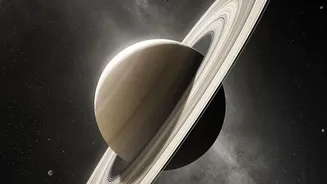
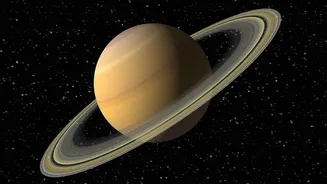
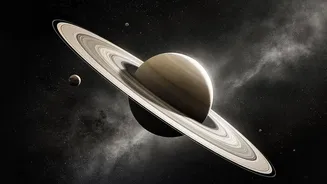
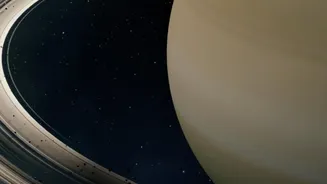
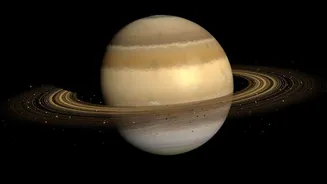
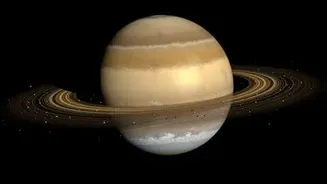
On the surface, Saturn’s rings and its magnetosphere seem like separate marvels. The rings are a breathtakingly vast and thin plane of ice and rock particles, orbiting the planet in a cosmic dance. The magnetosphere, on the other hand, is an immense,
invisible bubble of magnetism generated deep within the planet's interior. Similar to Earth's magnetic field, it shields Saturn from the harsh solar wind, a constant stream of charged particles from the Sun. For decades, these two systems were studied largely in isolation. One is a visible, physical structure of countless small bodies, while the other is an energetic field controlling the flow of plasma. But data, especially from the final orbits of NASA's Cassini spacecraft, has shown this separation is an illusion.
The Phenomenon of 'Ring Rain'
One of the earliest clues to a connection was a phenomenon dubbed 'ring rain'. Scientists observed that particles from the rings, mostly charged water molecules, were being pulled out of their orbit and funnelled down into Saturn's upper atmosphere. This isn't rain in the earthly sense, but a constant shower guided by the planet's powerful magnetic field lines. Early observations from the Voyager spacecraft and Earth-based telescopes hinted at this process, noting dark bands on Saturn where this influx of water appeared to be 'quenching' the natural glow of the ionosphere. This process has a significant impact, influencing the composition and temperature of vast swathes of Saturn's upper atmosphere. It also suggests that the rings are not a permanent fixture; they are actively eroding and feeding the planet they orbit.
Cassini's Grand Finale Revelations
The Cassini mission, which orbited Saturn from 2004 to 2017, completely revolutionised our understanding of this relationship. In its final, daring phase, called the 'Grand Finale,' the spacecraft made 22 dives through the previously unexplored gap between the innermost rings and the planet's cloud tops. During these passes, its instruments directly sampled the material and fields in this region. The data confirmed that an astonishing amount of material flows from the rings into the planet. Cassini's instruments detected a complex mix of water, methane, ammonia, carbon monoxide, molecular nitrogen, and even complex organic nanograins falling from the rings. This constant influx creates a unique chemistry in Saturn's ionosphere, a direct link between the icy rings and the gaseous atmosphere.
An Electrical Circuit Between Rings and Planet
The connection is more than just a gravitational transfer of material; it's an electrical one. The data revealed what is essentially a planetary-scale electrical circuit. Particles in the ionosphere and material from the rings become charged (ionized) and are then forced to flow along the magnetic field lines that connect the two regions. This movement of charged particles creates currents that flow between the rings and the planet's ionosphere. This system is incredibly dynamic. For example, the dense inner rings can cast 'shadows' that block the sunlight needed to ionize the atmosphere, causing dramatic drops in plasma density. Yet, even in shadow, some activity remains, indicating that the ring-atmosphere connection is a primary driver of Saturn's ionospheric environment, independent of the Sun's influence.
Why This Connection Matters
Understanding this intricate system is crucial for several reasons. Firstly, it tells us that Saturn's rings are disappearing at a much faster rate than previously thought. Some estimates suggest they could be gone in as little as 100 million years, which is a relatively short lifespan in cosmic terms. Secondly, this interaction helps solve long-standing mysteries about Saturn, such as why its magnetic field appears warped and its rotation rate seemed to vary. The drag from the ionized ring material affects the rotation of the magnetosphere itself. Ultimately, learning about this complex interplay at Saturn provides a new model for how giant planets work, showing that their rings are not just passive ornaments but active, influential components of the entire planetary system.