






A World of Cosmic Cotton Candy
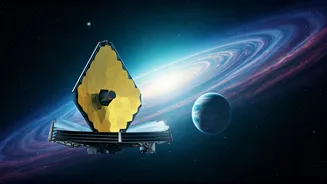
The wild world in question is an exoplanet named WASP-107b, located over 200 light-years away in the constellation Virgo. It’s a planet unlike anything in our solar system. While it has a mass similar to Neptune, its size is enormous, nearly as large
as Jupiter. This makes it one of the least dense planets ever discovered, earning it the nickname of a “puffy” or “cotton candy” planet. This unique fluffiness is a gift to astronomers. A less dense atmosphere allows the James Webb Space Telescope (JWST) to peer an estimated 50 times deeper into its layers than it could with a dense planet like Jupiter, offering an unprecedented window into its atmospheric secrets.
Raining Sand and Sulfur Skies
What Webb has found in those atmospheric layers is nothing short of extraordinary. The telescope’s data reveals the presence of clouds, but these are not the water clouds of Earth. They are made of silicate particles—the primary component of sand. Scientists believe the planet has a dynamic weather system that mimics Earth's water cycle, but with a much grittier substance. In the planet's deeper, hotter interior, these silicate particles vaporize. They then rise to the cooler upper atmosphere, where they condense to form clouds. From these clouds, it effectively rains hot sand, which falls back toward the interior to begin the cycle anew. Adding to the strangeness, Webb also detected sulfur dioxide, a gas known on Earth for the smell of a freshly struck match. Its presence was a surprise to scientists, as models didn't predict it would exist in an atmosphere this relatively cool.
How Webb Reads the Forecast
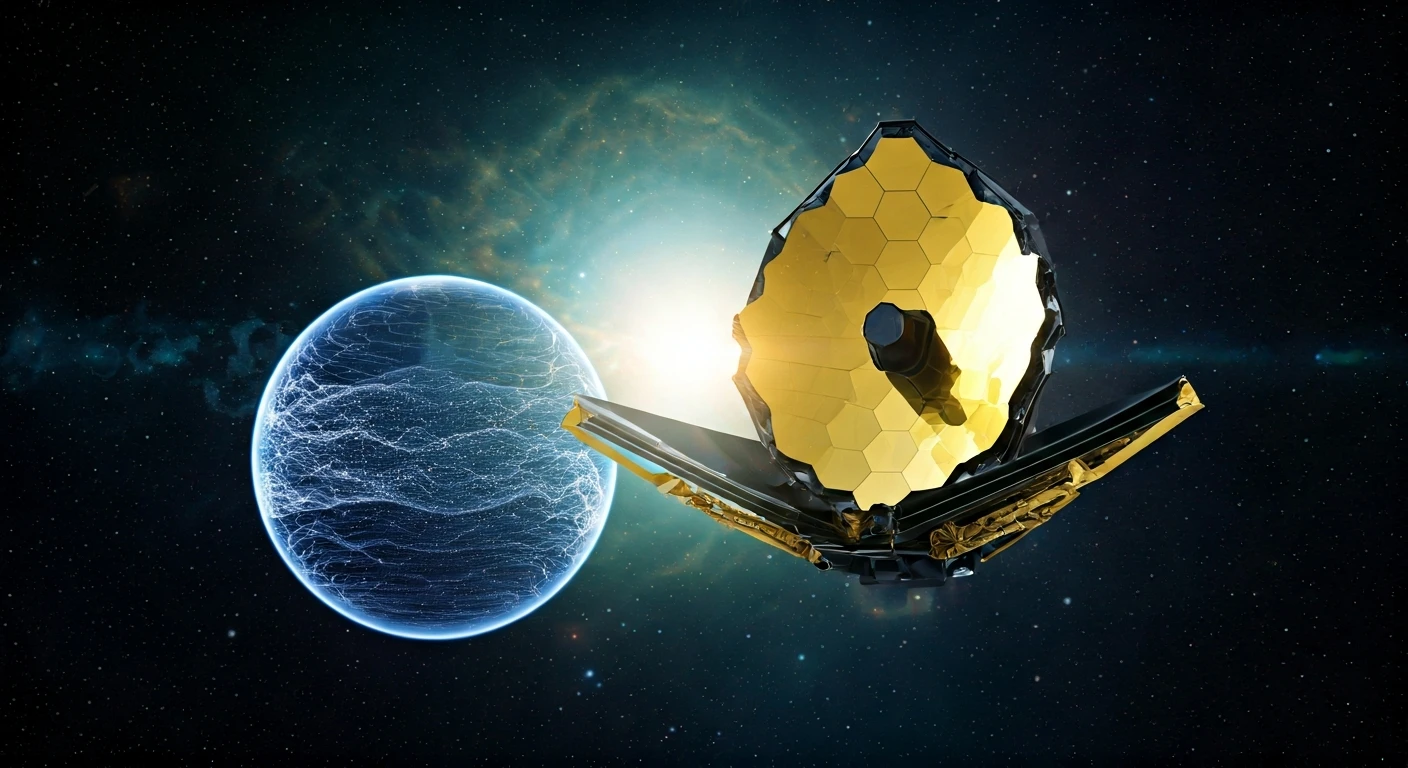
Observing weather from light-years away sounds like science fiction, but it's the reality of the JWST's power. The telescope uses a technique called transmission spectroscopy. As WASP-107b passes in front of its host star from our perspective, the starlight filters through the planet's atmosphere. Different chemical elements and compounds in the atmosphere absorb specific wavelengths, or colours, of this light. By capturing the spectrum of this filtered light with its sensitive infrared instruments, like the Mid-Infrared Instrument (MIRI), Webb can identify the chemical fingerprints of the molecules present. This process allows scientists to create a detailed chemical inventory of the planet's atmosphere, identifying everything from water vapour to the fine grains of sand floating high above the surface.
The Mystery of the Missing Methane
Sometimes, what isn't there is just as important as what is. In the case of WASP-107b, astronomers were struck by the notable absence of methane. For a planet of its type, scientific models predicted that methane should be a significant component of its atmosphere. The lack of it provides a crucial clue: the planet's interior must be significantly hotter than previously thought. This intense internal heat, likely generated by the gravitational pull of its star on its slightly elliptical orbit, would destroy methane molecules before they can accumulate in the upper atmosphere. This finding not only solves one puzzle about WASP-107b but also helps explain why some low-density exoplanets are so 'puffy' in the first place.