






A Personal Spaceship
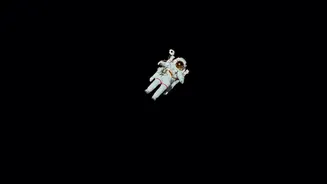
A modern spacesuit, like NASA's Extravehicular Mobility Unit (EMU), is far more than just a set of clothes. It’s a self-contained life support system designed to keep an astronaut alive and functional during a spacewalk. It provides oxygen, removes exhaled
carbon dioxide, offers a communication system, and even contains a drink bag. But its most critical job is to create a survivable bubble against the three biggest threats of space: the vacuum, extreme temperatures, and radiation. Made of up to 16 distinct layers of material, each component has a specific job in defending the astronaut from the harshest environment imaginable.
Battling the Vacuum
The vacuum of space is perhaps the most immediate danger. Without the pressure of an atmosphere, a person would lose consciousness in about 15 seconds. The fluids in the body would begin to turn to vapour in a process called ebullism. To combat this, a spacesuit has an internal pressure system. The innermost layers include a urethane-coated nylon 'bladder' that holds in the air, creating a pressurized environment of about 4.3 pounds per square inch (psi) of pure oxygen. A layer outside of that, called the restraint layer, is made of sturdy Dacron and prevents the bladder from ballooning outwards like a tire. This restraint layer is crucial for maintaining the suit's shape and allowing the astronaut to move and bend their joints.
The Ultimate Temperature Control
In Earth's orbit, temperatures can swing wildly from a scorching 121°C in direct sunlight to a frigid -157°C in the shade. A spacesuit must act like a perfect thermos to protect the astronaut from both. The first line of defence is actually a cooling system. Astronauts generate significant body heat while working, which can be dangerous in an insulated suit. They wear a Liquid Cooling and Ventilation Garment, essentially a set of spandex long underwear with about 300 feet of thin tubes woven into it. Cool water circulates through these tubes to draw heat away from the body. For insulation from the outside, the suit has multiple layers of aluminised Mylar, which reflect heat, separated by spacer fabric. The outermost layer is a white, reflective fabric that helps repel the intense heat of the sun.
A Shield Against Radiation
Space is flooded with radiation, from the Sun's powerful ultraviolet (UV) rays to high-energy cosmic rays from deep space. While a spacesuit cannot block all radiation, especially the most energetic particles, it provides vital protection. The helmet's visor has a special coating that reflects harmful UV radiation, much like high-end sunglasses. The suit's multiple layers, including the reflective Mylar and tough outer shell, help to block a significant amount of particle radiation. However, this shielding has its limits. For this reason, space agencies carefully plan spacewalks to avoid periods of high solar activity, like solar flares, to minimize the astronaut's total exposure.
More Than Just Protection
Beyond these primary protective functions, the spacesuit is a complete mobile habitat. The Hard Upper Torso, a rigid fibreglass shell, serves as the central hub, connecting the helmet, arms, and the life support backpack. This backpack, the Primary Life Support System, contains the oxygen tanks, batteries, radio, and the system for removing carbon dioxide from the air the astronaut breathes. The suit's outermost layers are also incredibly tough, made of a blend of materials including Gore-Tex, Kevlar, and Nomex, to protect against tears and impacts from tiny, high-speed micrometeoroids. Every single component works in harmony to turn an environment of certain death into a place where humanity can work and explore.