



Artemis: A New Generation on the Moon
The Artemis program represents NASA's monumental effort to return humans to the Moon for the first time in over half a century. But this is not a repeat of Apollo. The goal is to establish a sustainable human presence on and around the Moon, creating
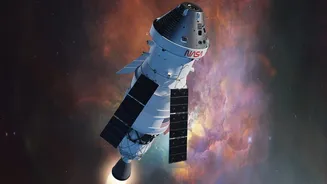
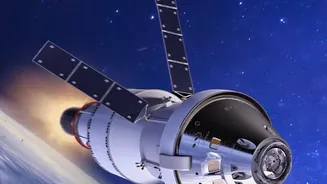
a blueprint for future missions to Mars. The program kicked off with the uncrewed Artemis I test flight in 2022, followed by the crewed Artemis II mission in April 2026, which sent four astronauts on a journey around the Moon. This flight tested the Orion spacecraft's life-support systems and deep-space capabilities, setting a new record for the farthest humans have traveled from Earth. Future missions, like Artemis III and IV, aim to land astronauts, including the first woman, on the lunar surface near the south pole, an area believed to contain water ice. These missions are a critical step toward building a long-term lunar base and an orbiting Gateway station, which will serve as a staging point for deeper space exploration.
Mars Sample Return: Bringing the Red Planet to Earth
For decades, rovers have analyzed Mars from its surface, but studying Martian rocks in terrestrial labs could be a game-changer. The Mars Sample Return (MSR) campaign, a joint effort with the European Space Agency (ESA), is one of the most ambitious robotic missions ever conceived. The first step is already complete: NASA's Perseverance rover is currently collecting and caching scientifically compelling rock and soil samples in Jezero Crater, the site of an ancient river delta. The next phase involves sending a Sample Retrieval Lander to the surface. This lander would deploy a small rocket, the Mars Ascent Vehicle, to launch the collected samples into orbit around Mars—a first for any planet besides Earth. An orbiter would then capture this container and return it to Earth. Analyzing these pristine samples could revolutionize our understanding of Martian geology, its past climate, and—most tantalizingly—whether the Red Planet ever hosted life.
Europa Clipper: Searching for Life in an Ocean World
Beneath the icy shell of Jupiter's moon Europa lies a vast, saltwater ocean that may contain more than twice the amount of water in all of Earth's oceans. This makes Europa one of the most promising places in our solar system to search for life. Launched in October 2024, NASA's Europa Clipper is on a long journey to investigate this potential. The spacecraft will arrive in the Jupiter system in 2030 and perform dozens of close flybys of Europa, some as low as 16 miles (25 kilometers) above the surface. It won't orbit Europa directly, a strategy to protect its sensitive instruments from Jupiter's intense radiation. Armed with cameras, spectrometers, and ice-penetrating radar, Clipper will characterize the moon's icy shell, confirm the presence of its subsurface ocean, and even search for plumes of water vapor that might be erupting from the surface, offering a direct sample of the ocean's chemistry.
Dragonfly: A Drone on a Distant Moon
Saturn's largest moon, Titan, is a strange and fascinating world. It has a thick, nitrogen-rich atmosphere, weather, clouds, and rivers and lakes of liquid methane. To explore this unique environment, NASA is sending Dragonfly, a car-sized, nuclear-powered quadcopter. Scheduled to launch in July 2028 and arrive in 2034, Dragonfly will be the first powered aircraft to fly on another moon. Titan's dense atmosphere and low gravity make it an ideal place for aerial exploration. The rotorcraft will be able to fly dozens of miles in a single trip, hopping between diverse geological sites—from organic sand dunes to the floor of an impact crater where liquid water may have once mixed with the moon's abundant organic materials. Dragonfly's primary goal is to study prebiotic chemistry, investigating the building blocks of life on a world vastly different from our own.
Nancy Grace Roman Space Telescope: A Panoramic View of the Cosmos
Set to launch by August 2026, the Nancy Grace Roman Space Telescope will be a powerful new eye on the universe, building on the legacies of Hubble and Webb. While its primary mirror is the same size as Hubble's, Roman's Wide-Field Instrument will provide a field of view 200 times larger, allowing it to capture panoramic images of the cosmos with incredible detail. This capability will enable it to tackle some of the biggest mysteries in astronomy. Roman will map the structure of the universe to study dark energy, the mysterious force causing cosmic expansion to accelerate. It will also conduct a massive survey for exoplanets using a technique called gravitational microlensing, which is expected to uncover thousands of new worlds, including free-floating planets not orbiting any star.