



Seeing the Universe in a New Light
Much of the universe is hidden from our eyes, which can only perceive a tiny slice of the light spectrum. Infrared light, which we feel as heat, has longer wavelengths than visible light. This property is crucial for astronomy because it allows telescopes
to see through the vast clouds of cosmic gas and dust that would otherwise block our view. While visible light gets scattered or absorbed by these dust particles, infrared light can pass through them relatively unhindered. This ability transforms opaque, dark patches of the sky into transparent windows, giving astronomers access to a 'hidden' universe of cosmic activity that is otherwise impossible to observe.
Witnessing the Birth of Stars
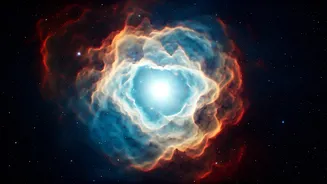
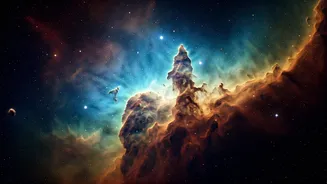
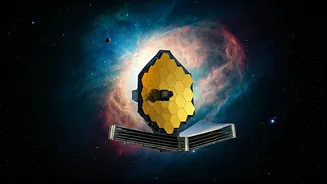
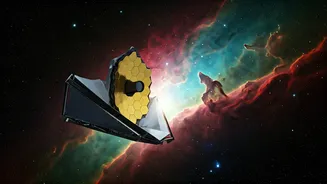
One of the most significant applications of infrared astronomy is studying star formation. Stars are born deep inside dense, cold clouds of gas and dust known as stellar nurseries. These cocoons are completely opaque to optical telescopes, making the earliest stages of a star's life invisible. Infrared telescopes, however, can pierce these dusty veils. They detect the heat radiated by protostars—infant stars still gathering mass from their surrounding cloud. By observing these regions, astronomers can watch stars and their planetary systems come into being, providing invaluable information about how our own Sun and solar system may have formed. Stunning images of regions like the Pillars of Creation and the Carina Nebula from JWST have revealed thousands of newly forming stars that were previously concealed.
Peering Back to the Dawn of Time
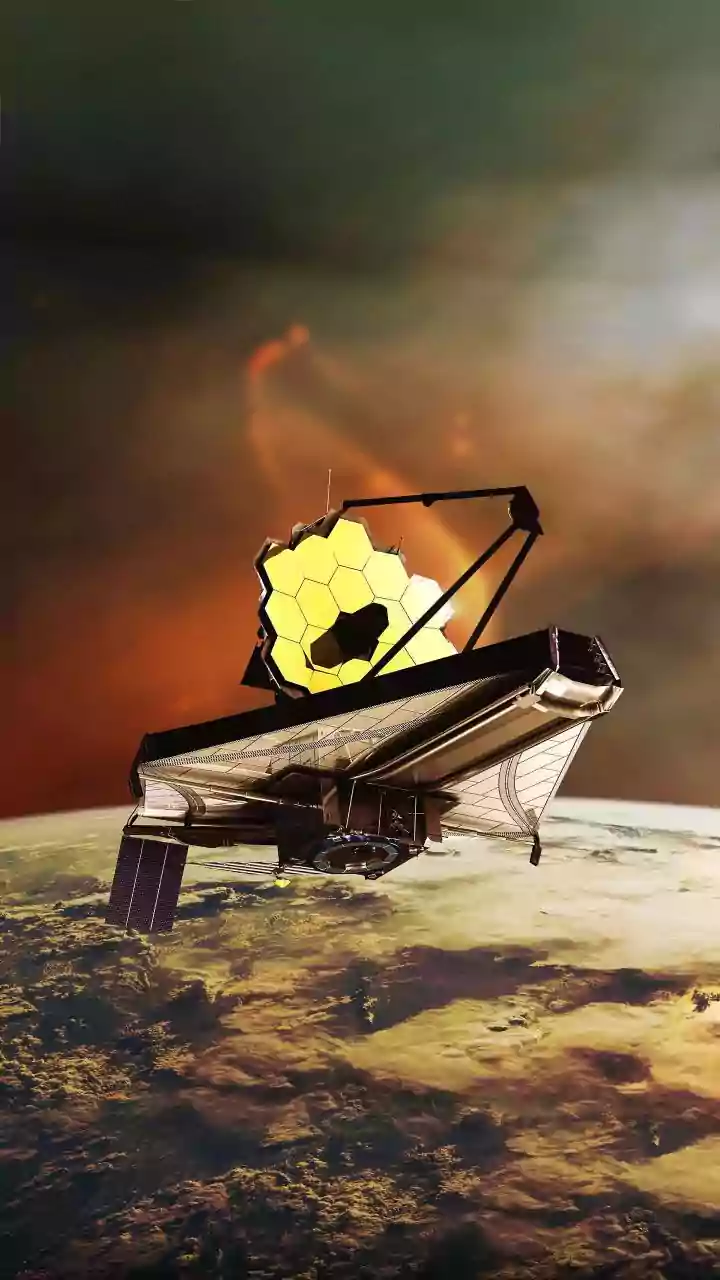
Infrared light also acts as a time machine. The universe has been expanding since the Big Bang, and this expansion stretches the light that travels through it. This phenomenon, known as 'cosmological redshift', causes light that was originally emitted in shorter, visible, or ultraviolet wavelengths from the most distant objects to be stretched into the longer wavelengths of infrared light by the time it reaches our telescopes. Therefore, to see the first galaxies that formed just a few hundred million years after the Big Bang, we must look for them in the infrared spectrum. Telescopes like JWST are designed specifically for this task, and they have already discovered galaxies that are far more massive and complex than models of the early universe predicted, forcing a rethink of how quickly the first cosmic structures formed.
Searching for Signs of Life on Other Worlds
The search for life beyond Earth has been supercharged by infrared technology. When an exoplanet passes in front of its host star, a tiny fraction of the starlight filters through the planet's atmosphere. By analyzing this light with a technique called transmission spectroscopy, astronomers can identify the chemical composition of that atmosphere. Different molecules absorb specific wavelengths of light, leaving a unique chemical fingerprint. Infrared spectrographs are particularly adept at detecting key molecules that could indicate habitability, such as water, methane, and carbon dioxide. JWST has already provided unprecedentedly detailed atmospheric profiles of exoplanets, making the first-ever detection of carbon dioxide on a world outside our solar system and fueling the ongoing quest to find another Earth.