




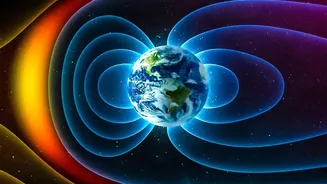


Earth: A Giant, Invisible Magnet
The entire principle of a compass relies on the fact that our planet behaves like a gigantic magnet. Deep beneath our feet, the Earth's outer core is a churning ball of molten iron and nickel. The movement of this electrically conductive liquid, combined
with the planet's rotation, generates powerful electric currents. This process, known as a geodynamo, creates a massive magnetic field that extends from the interior of the Earth far out into space, forming a protective shield called the magnetosphere. This field has a north and south pole, just like a simple bar magnet.
The Heart of the Compass
At its core, a compass is a surprisingly simple device. Its most crucial component is a lightweight, magnetized needle, typically made of iron or steel. This needle is balanced on a low-friction pivot, allowing it to rotate freely with minimal resistance. By stroking the steel needle with a strong magnet during manufacturing, its internal magnetic particles are all aligned in the same direction, turning the needle into a small, permanent magnet with its own north and south pole. In many modern compasses, this needle assembly is housed in a liquid-filled capsule, which helps to dampen vibrations and allows the needle to settle more quickly.
An Unseen Dance of Forces
So, what happens when you hold a compass? The tiny magnet in the needle interacts with the giant magnetic field of the Earth. Following a fundamental rule of magnetism—that opposite poles attract—the north-seeking pole of the compass needle is pulled into alignment with the Earth's magnetic field lines. These invisible lines of force cause the needle to rotate until it settles, pointing in the direction of the planet's magnetic pole. This is why a compass needle, no matter where you are (with a few exceptions near the poles themselves), will reliably orient itself along a north-south line.
The Two Norths: Magnetic vs. True
Here’s a crucial detail for anyone using a compass for serious navigation: the 'north' a compass points to is not the same as the 'north' you see at the top of a globe. A compass needle points to the Magnetic North Pole. The Geographic North Pole, or True North, is the fixed point that marks the top of Earth's rotational axis. The Magnetic North Pole, however, is a wandering point that shifts its position over time due to the changing flow of molten metal in the Earth's core. The two poles are close, but not in the same location.
Navigating with Declination
The angular difference between True North and Magnetic North from any given point on the Earth's surface is called magnetic declination. This angle varies depending on your location. For example, the declination in Maine is different from the declination in Texas. For casual use, this difference might not matter. But for precise navigation, pilots and mariners must account for it. Topographic maps and nautical charts will indicate the local declination, allowing a navigator to adjust their compass reading to find the direction of True North and plot an accurate course.