





Why Binoculars Are Your Secret Weapon
Many experienced astronomers advise beginners to start not with a telescope, but with a good pair of binoculars. The reason is simple: they are portable, affordable, and incredibly easy to use. Unlike a telescope, which has a steep learning curve, binoculars are ready
to go the moment you step outside. They offer a wide field of view, which makes it much easier to find your way around the constellations and locate celestial objects. Using both eyes is also more comfortable and provides a natural, three-dimensional feel to the view, which can be more immersive than squinting through a single eyepiece.
Decoding the Numbers: 7x50 vs. 10x50
When you look at binoculars, you'll see two numbers, such as 7x50 or 10x50. The first number is the magnification (7x or 10x power), and the second is the diameter of the main lenses in millimeters (50mm). A larger second number means the binoculars can gather more light, making faint objects appear brighter. For stargazing, 50mm is a great starting point. The choice between 7x and 10x magnification is a matter of preference. 7x50 binoculars are often easier to hold steady and offer a wider view, which is great for sweeping across the Milky Way. A 10x50 pair offers more powerful magnification, allowing you to see more detail on the Moon or resolve tight star clusters, but any hand shake will also be magnified. For beginners, a 10x50 is often recommended as an excellent all-around choice for astronomy.
Getting a Steady View
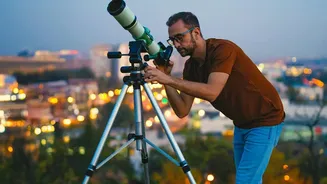
The key to seeing detail in the night sky is keeping your view as steady as possible. The slightest shake can turn a star cluster into a blurry smudge. While simply bracing your elbows on a solid surface like a car roof or a deck railing can help, one of the best techniques is to observe while sitting or lying down. A garden recliner chair allows you to look straight up without straining your neck. For even more stability, especially with higher-magnification binoculars like 10x50s or larger, investing in a tripod adapter is a game-changer. Most astronomy-friendly binoculars have a small, capped socket between the lenses where you can screw in an adapter, allowing you to mount them on a standard camera tripod for a perfectly stable, hands-free experience.
Your First Celestial Tour
With your binoculars ready, what should you look for? The night sky is full of amazing sights that are perfect for binocular viewing. The Moon is the best place to start; aim for the 'terminator'—the line between the sunlit and dark parts—where craters and mountains cast long shadows, revealing incredible detail. Next, find Jupiter; with a steady hand, you can spot its four largest moons appearing as tiny pinpricks of light flanking the planet. Star clusters are also spectacular. The Pleiades (M45), also known as the Seven Sisters, explodes into dozens of glittering stars in binoculars. In the constellation of Orion, look for the fuzzy patch of the Orion Nebula (M42), a stellar nursery where new stars are being born. And if you are under dark skies, you can even spot the faint, oval glow of the Andromeda Galaxy (M31), the closest major galaxy to our own Milky Way.