





More Than an Astronaut
When NASA astronaut Anil Menon launches to the International Space Station (ISS) on July 14, he’ll be carrying more than just the dreams of a nation. The son of Indian and Ukrainian immigrants, Menon’s journey to orbit is a testament to a uniquely modern
skillset. Selected from a pool of over 12,000 applicants, the U.S. Space Force colonel isn't just a pilot; he's an emergency medicine physician with extensive experience in extreme environments. Before joining NASA’s 2021 astronaut class, he served on the frontlines in Afghanistan, provided medical care to climbers near Mount Everest, and was a first responder to natural disasters in Haiti and Nepal. This background is crucial, as it highlights a shift in what it means to be an astronaut today. The job is no longer just about flying the craft; it's about living and working productively in space for months on end.
The Space-Age Doctor
Menon’s medical expertise is central to his mission. Prior to his selection as an astronaut, he was a NASA flight surgeon, supporting crews on the ISS. He then became SpaceX's very first flight surgeon, where he was instrumental in developing the medical program for the company's historic first human flights, including the groundbreaking Demo-2 mission. This experience places him at the intersection of public and private spaceflight, giving him a rare perspective on crew health and safety. His upcoming eight-month stay on the ISS as a flight engineer for Expeditions 74 and 75 is a logical extension of this work. He isn’t just a passenger on a flying laboratory; he is one of its most important scientific instruments, both as a researcher and a test subject.
A Mission of Utility
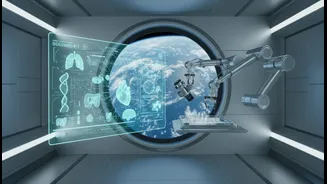
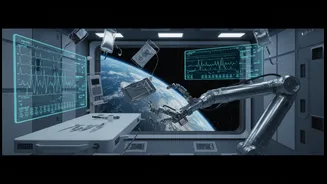
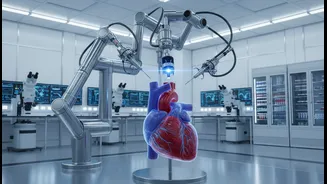
The 'bigger story' of Menon's mission lies in the experiments he will conduct. For over two decades, the ISS has served as a world-class laboratory, but the focus has sharpened from exploration to tangible utility. Menon's work will directly contribute to this. He is tasked with conducting research that has direct benefits for life on Earth and prepares humanity for future deep-space voyages to the Moon and Mars. His experiments include studying the effects of microgravity on blood flow, which could yield insights into aging and cardiovascular disease on Earth. He will also test bioprinting of vascular structures and use augmented reality with ultrasound, pioneering methods for autonomous medical care on long-duration missions where a doctor might not be available. This work is essential for the Artemis program and a sustained human presence beyond low-Earth orbit.
The Floating Laboratory
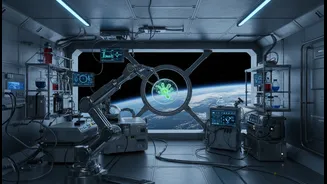
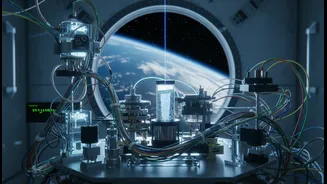
Menon’s research is part of a broader scientific agenda aboard the ISS, which has hosted over 3,000 experiments from more than 100 countries. The station's unique microgravity environment allows for breakthroughs impossible on the ground. Scientists study everything from fluid physics and materials science to muscle atrophy and the growth of protein crystals for new medicines. For example, Menon will continue work on refining the in-space production of semiconductor crystals, which could lead to more powerful computer components and advanced medical devices. By treating the American segment of the ISS as a national laboratory, NASA has opened the door for commercial and academic research that drives innovation across multiple industries. Menon’s mission is a prime example of this model in action, where the primary goal is not just to go, but to do—to produce knowledge and technology that has real-world applications.