


A New Era of Discovery
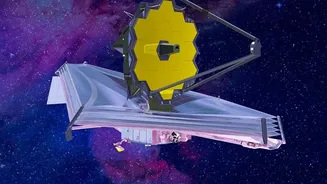
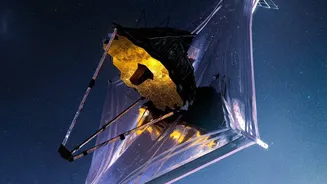
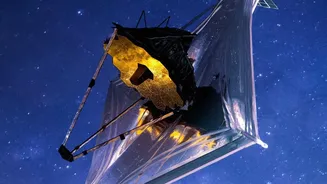
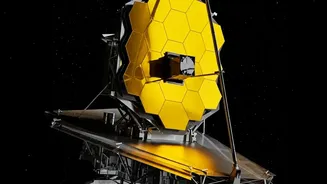
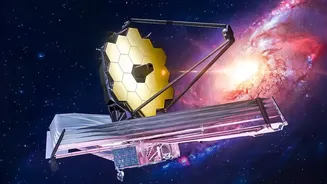
The James Webb Space Telescope (JWST) has opened a new frontier in astronomy, repeatedly confirming the presence of water vapour on planets orbiting distant stars. This isn't a single, isolated finding but a growing catalogue of detections that are fundamentally
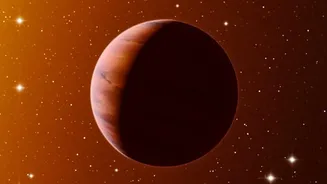
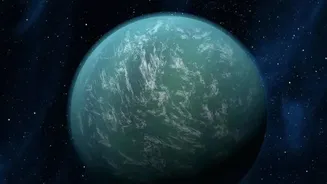
changing our understanding of planetary systems. One of the most studied examples is K2-18 b, a planet about 124 light-years away that is more massive than Earth and orbits its star within the habitable zone. JWST's observations have confirmed not only water vapour but also methane and carbon dioxide in its atmosphere, suggesting it could be a 'Hycean' world—a planet potentially covered by a water ocean with a hydrogen-rich atmosphere. Other recent studies have targeted worlds like GJ 9827d, a scorching 'steam world' whose atmosphere appears to be composed almost entirely of water vapour, and WASP-80 b, a 'warm Jupiter' where both water and methane have been spotted. These discoveries demonstrate the telescope's unprecedented ability to analyse a diverse range of exoplanets, from potentially habitable super-Earths to exotic gas giants.
Decoding Light from Distant Worlds
How can scientists possibly know what's in the air of a planet hundreds of light-years away? The answer lies in a technique called transmission spectroscopy. Think of it as a cosmic barcode scanner. When an exoplanet passes in front of its host star—an event known as a transit—a tiny amount of starlight filters through the planet's atmosphere. Molecules in that atmosphere, such as water vapour, methane, or carbon dioxide, absorb specific wavelengths (or colours) of light. The JWST's highly sensitive instruments, called spectrographs, capture the starlight before, during, and after the transit. By subtracting the star's own light spectrum from the combined spectrum during the transit, astronomers can isolate the light that passed through the atmosphere. The missing slivers in this light spectrum are like fingerprints, revealing exactly which molecules are present. It's a painstaking process, but it allows scientists to chemically analyse alien skies from across the galaxy.
The Elixir of Life?
The intense focus on water is for a simple reason: on Earth, all life as we know it requires liquid water to exist. It’s a superior solvent that facilitates the chemical reactions necessary for biology. Finding water vapour is therefore the crucial first step in assessing a planet's potential for habitability. Astronomers often focus their search on the 'habitable zone', the region around a star where conditions are not too hot and not too cold for liquid water to exist on a planet's surface. The discovery of water vapour on a planet like K2-18 b, which orbits within this zone, is particularly exciting. It suggests the right ingredients could be in place. JWST has even detected water vapour in the planet-forming disk of a young star system called PDS 70, implying that rocky planets could be born with water readily available, rather than having it delivered later by comets or asteroids.
More Than Just Water
While finding water is a landmark achievement, scientists are quick to caution that water vapour alone does not equal life. The planet GJ 9827d, for instance, has an atmosphere thick with water, but its surface temperature is a blistering 430 degrees Celsius, making it an inhospitable steam world. A planet's true habitability depends on a complex interplay of factors, including its temperature, its atmospheric pressure, and the presence of a full suite of elements. Many of the planets where water has been found, like K2-18 b, are 'sub-Neptunes'—significantly larger and more massive than Earth, with thick hydrogen-rich atmospheres that may not be conducive to life as we know it. The ultimate goal for scientists is to find 'biosignatures'—a combination of gases like oxygen, methane, and carbon dioxide in proportions that suggest they are being produced by living organisms. Finding one ingredient is a huge step, but the full recipe for life is far more complex.