




A New Cosmic Explorer Takes Flight
After years of development, NASA's Nancy Grace Roman Space Telescope successfully lifted off aboard a SpaceX Falcon Heavy rocket on August 30, 2026. The observatory is now traveling to its operational orbit about 1.5 million kilometers from Earth at a gravitationally
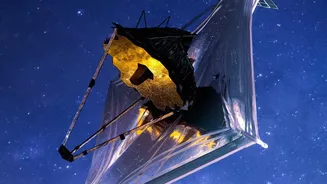
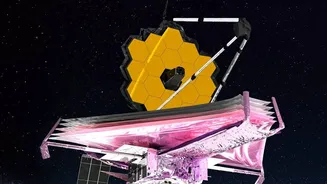
stable location known as the second Lagrange point, or L2. This is the same region of space where the James Webb Space Telescope (JWST) operates. Named after Nancy Grace Roman, NASA’s first chief of astronomy and the “mother of Hubble,” this flagship mission is designed not to replace its famous predecessors but to complement them with a powerful new capability. While Hubble and Webb are like zoom lenses, offering incredibly detailed views of specific targets, Roman is the ultimate wide-angle camera, built to survey vast stretches of the cosmos with unprecedented speed and scale.
The Wide-Angle Advantage
Roman's primary instrument, the Wide Field Instrument, is a 300-megapixel camera that gives it a field of view at least 100 times larger than Hubble's infrared camera, all while maintaining a similar, razor-sharp resolution. This means that in a single snapshot, Roman can capture an area of the sky that would take Hubble hundreds of images to cover. This survey power is the telescope's superpower. Scientists estimate that it can map the sky up to 1,000 times faster than Hubble. Its mission is to create enormous cosmic maps, providing the big-picture context that has been missing. By identifying countless new objects of interest—from distant galaxies to exploding stars—Roman will create a rich catalog of targets for Webb and Hubble to investigate in greater detail, making the entire fleet of space telescopes more powerful.
Hunting the Universe’s Biggest Ghost: Dark Energy
One of Roman’s primary scientific goals is to tackle one of the most profound mysteries in all of physics: dark energy. This enigmatic force is believed to make up about 68% of the universe and is responsible for causing the expansion of the cosmos to accelerate. But scientists still don't know what it is. Roman will investigate dark energy by embarking on huge surveys to map the location and distribution of over a billion galaxies. It will also hunt for thousands of specific stellar explosions called Type Ia supernovae. By precisely measuring how galaxies are clustered and how light from distant supernovae has been stretched over cosmic time, astronomers can trace the expansion history of the universe and test theories about the true nature of dark energy.
Taking a Galactic Planet Census
Beyond cosmology, Roman is set to revolutionize the search for worlds beyond our solar system. The mission is expected to conduct the largest exoplanet census ever attempted. Instead of primarily using the 'transit' method like the Kepler space telescope, Roman will specialize in a technique called gravitational microlensing. This method detects planets by observing the way a foreground star’s gravity briefly magnifies the light from a much more distant, background star. If that foreground star has a planet, its own gravity creates a second, smaller blip in the light. This technique is sensitive enough to find planets much farther from their star, rogue planets that wander the galaxy alone, and worlds with masses as small as Mars. Scientists anticipate Roman could discover on the order of 100,000 new exoplanets, completely transforming our understanding of planetary systems.
Paving the Way for Future Discoveries
In addition to its wide-field surveys, Roman carries a technology demonstrator called the Coronagraph Instrument. This device is designed to block the overwhelming glare of a star, making it possible to directly image the faint planets orbiting it. The Roman Coronagraph is expected to be 100 to 1,000 times more powerful than previous instruments of its kind, and it will serve as a crucial stepping stone for future missions, like the proposed Habitable Worlds Observatory, which aims to search for signs of life on Earth-like planets. While the telescope's primary mission is slated for five years, it is expected to generate a deluge of data—about 1.4 terabytes every day—that will fuel discoveries across all fields of astrophysics for decades to come.