


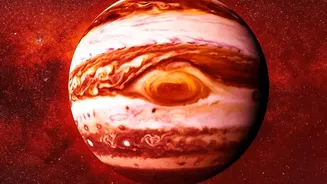
Welcome to the 'Hot Jupiters'
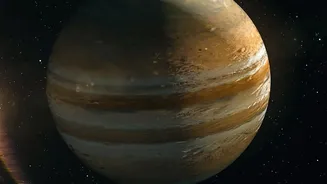
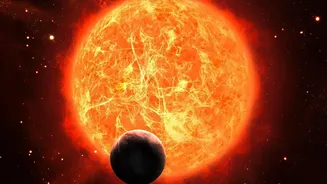
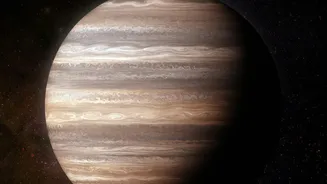
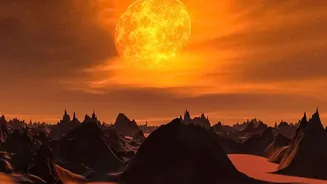
The planets capturing scientists' attention belong to a category known as 'ultra-hot Jupiters.' These are gas giants, similar in size to our own Jupiter, but they orbit incredibly close to their parent stars. One such world, WASP-76b, located about 640
light-years away, completes a full orbit in just 1.8 Earth days. This extreme proximity means they are tidally locked, with one side perpetually facing the star's blistering heat and the other shrouded in eternal night. The dayside of a planet like WASP-76b can reach temperatures above 2,400 degrees Celsius, hot enough to vaporize not just water, but metals like iron. This creates some of the most extreme environments ever observed.
Forecasting a Shower of Iron
The concept of 'iron rain' sounds fantastical, but it's the result of basic physics in an extreme setting. On the scorching dayside of WASP-76b, iron evaporates into the atmosphere. Then, ferocious winds, which can travel faster than the speed of sound, whip this iron vapor over to the cooler, 'night' side of the planet. There, temperatures drop to around 1,500 degrees Celsius. While still incredibly hot by our standards, this is cool enough for the iron vapor to condense back into liquid droplets, forming clouds of molten iron that then fall as rain. Scientists first suspected this phenomenon when they detected a strong signature of iron vapor at the boundary where day turns to night, but not on the other side where night turns to day, suggesting the iron had rained out of the atmosphere.
Winds Faster Than Sound
The engine driving this bizarre weather is the planet's powerful wind system. The massive temperature difference between the day and night sides generates atmospheric currents that are almost unimaginably fast. Recent observations of several hot Jupiters have clocked wind speeds between 7,000 and 25,000 kilometres per hour. On a planet named KELT-9b, scientists measured day-to-night wind speeds of up to 11.7 km/s, which is supersonic. For comparison, the fastest winds ever recorded on Jupiter in our own solar system reached only about 1,500 kilometres per hour. These winds are not just fast; they are crucial for transporting heat and chemical elements around the planet, creating the dynamic and violent weather patterns that telescopes are now beginning to map.
The Telescopes That Make It Possible
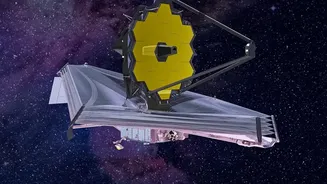
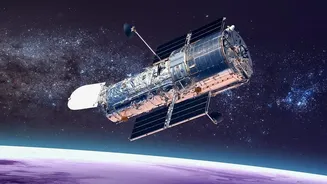
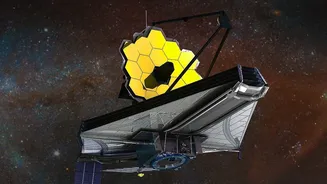
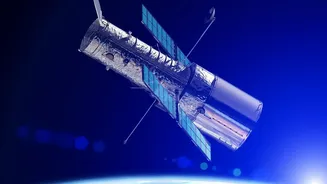
Detecting the chemical composition and wind patterns of an atmosphere hundreds of light-years away requires incredible technology. Astronomers primarily use a technique called spectroscopy. When a planet passes in front of its star, a tiny fraction of the starlight filters through the planet's atmosphere. By splitting this light into its component wavelengths, like a prism creating a rainbow, scientists can spot the tell-tale 'fingerprints' of different elements. Iron atoms, for example, absorb light at very specific wavelengths. Seeing those specific wavelengths disappear from the starlight tells astronomers that iron is present. Ground-based observatories like the Very Large Telescope (VLT) and space-based instruments like the James Webb Space Telescope (JWST) use powerful infrared spectrographs, which are particularly good at picking up the heat signatures and chemical compositions of these distant, searing worlds.