



A Sweet Discovery Near the Galactic Center
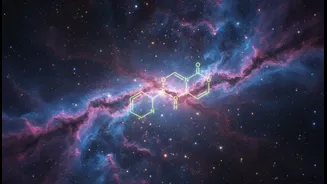
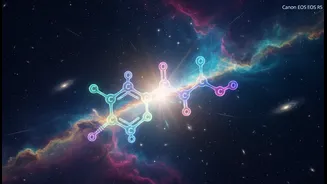
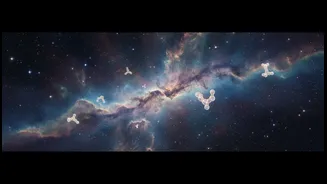
In a landmark finding, an international team of astronomers has made the first-ever direct detection of a true sugar in interstellar space. The molecule, called erythrulose, was identified in a dense molecular cloud named G+0.693-0.027, located roughly
26,700 light-years from Earth near the heart of the Milky Way. Using the powerful Yebes 40-meter and IRAM 30-meter radio telescopes in Spain, researchers scanned the cloud for specific chemical signatures. They detected 12 distinct radio signals that perfectly matched the unique spectral fingerprint of erythrulose, confirming its presence in this stellar nursery where new stars and planets are born. On Earth, this four-carbon sugar is found in small amounts in red raspberries and is also used in some sunless tanning products. Its discovery in space, however, is less about cosmetics and more about our cosmic origins.
What Makes Erythrulose So Special?
Erythrulose belongs to a class of compounds known as prebiotic molecules—the chemical precursors to life. Sugars are fundamental to biology as we know it; they form the structural backbone of DNA and RNA, the molecules that carry our genetic code, and they are a primary source of metabolic energy for cells. The major question for scientists has been how these essential sugars formed on early Earth, as lab experiments simulating prebiotic conditions have struggled to produce them in significant quantities. Erythrulose is particularly important because, in watery environments, it can transform into other sugars, including threose, which is considered a possible evolutionary predecessor to RNA. Its discovery suggests that the building blocks for more complex molecules like ribose—the 'R' in RNA—could form in space. This makes erythrulose a critical link between simple interstellar chemistry and complex biology.
How Do You Find a Molecule 26,700 Light-Years Away?
Detecting a specific molecule in the vastness of space is a monumental task. Astronomers do it using a technique called radio astronomy. Every molecule rotates and vibrates at specific frequencies, emitting or absorbing radio waves in a unique pattern, much like a barcode. To find erythrulose, scientists first had to know what to look for. In a laboratory, they measured the exact frequencies of its spectral signature. Then, they pointed highly sensitive radio telescopes, like the IRAM 30-meter instrument, towards the G+0.693-0.027 cloud, which is known to be a rich reservoir of complex molecules. By painstakingly sifting through the noise of countless cosmic signals, they were able to match the faint emissions from the cloud to the known signature of erythrulose, confirming its presence.
A Cosmic Delivery Service for Life?
The discovery of erythrulose in a pre-stellar cloud lends significant weight to a captivating theory about the origin of life on Earth: that its essential ingredients were delivered from space. Scientists have previously found sugars and other prebiotic molecules like amino acids inside meteorites and on asteroids, including samples returned from the asteroid Bennu. But finding a sugar in the interstellar medium itself pushes the origin of this chemistry back even further, to before planets and asteroids even form. The theory suggests that during a period known as the Late Heavy Bombardment, about 4 billion years ago, comets and asteroids rich in these molecules crashed into the young Earth, seeding it with the raw materials needed for life to emerge. This finding shows that the ingredients weren't just available in our solar system, but are likely common throughout the galaxy.
Challenging Our Understanding of Cosmic Chemistry
Interestingly, the team found that erythrulose was at least eight times more abundant than simpler, three-carbon sugars they searched for. This was unexpected, as the prevailing view was that complex molecules in space build up slowly, one carbon atom at a time. The high concentration of erythrulose suggests it may form more efficiently from the combination of simpler, two-carbon molecules on the surface of icy dust grains. With 14 atoms, erythrulose is one of the largest and most complex non-cyclic molecules ever detected in the interstellar medium. This discovery challenges our models of astrochemistry and hints that the universe is an even more efficient factory for producing life's building blocks than previously imagined, opening the door to finding even more complex prebiotic molecules among the stars.