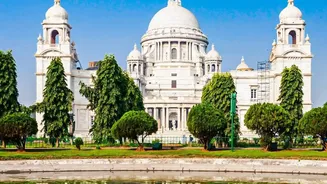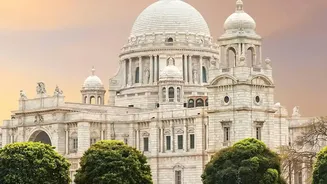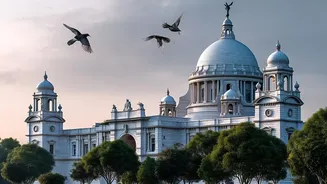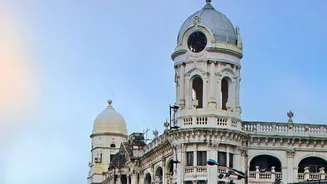







Why was Kolkata once called the 'London of India'? The answer lies not just in history books, but in the grand, stone-faced buildings of its old commercial districts, a stunning architectural legacy of its time as the British Empire's second city.
The Capital of the Raj
For
nearly 140 years, from 1772 until 1911, Kolkata (then Calcutta) was the capital of British India. This status transformed it into the most important commercial, financial, and political centre in Asia. The British East India Company and later the Crown invested heavily in creating an administrative headquarters that mirrored the grandeur of their own capital. The city grew rapidly, becoming a bustling hub for trade in jute, tea, and coal, connecting the subcontinent to Britain, Europe, and Southeast Asia. This immense economic power was consciously expressed through architecture, giving rise to another of the city's nicknames: 'City of Palaces'. The urban planning and monumental buildings were so reminiscent of European capitals that the comparison to London became a natural one.
B.B.D. Bagh: The Seat of Power
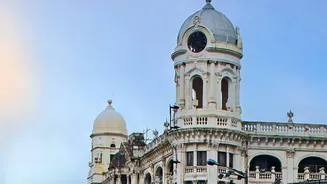
The heart of this 'London of India' was undoubtedly Dalhousie Square, now known as B.B.D. Bagh. This area was the nucleus of the colonial city, built around the central Lal Dighi water tank. It was, and in many ways still is, the administrative and commercial epicentre of Kolkata. The square is ringed by an staggering concentration of colonial heritage buildings. Dominating the northern flank is the monumental Writers' Building. Originally built in 1777 to house the junior clerks ('writers') of the East India Company, it later became the main government secretariat. At the western edge stands the magnificent General Post Office (GPO), with its towering Corinthian columns and grand dome, designed by Walter Granville and completed in 1868 on the site of the original Fort William.
A Symphony in Stone
The nickname is most clearly understood by simply looking at the buildings themselves. The architecture is a powerful display of various European styles. The Writers' Building showcases Greco-Roman influences, while St. Andrew's Kirk, built for the city's Scottish community, adds a classical touch with its tall white steeple. The GPO is a prime example of Neoclassical grandeur. Elsewhere, one can find a blend of Victorian, Gothic, and Indo-Saracenic designs, which fused British and Mughal elements. Buildings like the former Hong Kong and Shanghai Bank headquarters and the Royal Exchange building further cemented the area's role as a global financial hub, their imposing facades speaking a language of commercial might understood from London to Hong Kong.
The European Promenade of Chowringhee
While B.B.D. Bagh was the centre of power, Chowringhee Road was the centre of European social life. What was once a jungle path leading to the Kalighat temple transformed into Calcutta's grandest thoroughfare. After the construction of the new Fort William in the mid-18th century, wealthy Europeans began building palatial residences along this road, cementing the 'City of Palaces' moniker. It became a fashionable promenade lined with magnificent stores, hotels like the Grand Hotel, and entertainment venues, lit by gas lamps as early as 1857. The road represented the sophisticated, leisurely side of colonial life, a stark contrast to the administrative hustle of Dalhousie Square but equally vital to the city's European character.
A Living, Breathing Heritage
Today, these old commercial districts are far from being sterile museum pieces. B.B.D. Bagh is still referred to as 'Office Para' (the office neighbourhood), a bustling hub where generations of Kolkatans have worked. The grand colonial structures now house government offices, banks, and businesses. The area is a fascinating blend of past and present; street food vendors sell their wares in the shadows of neoclassical columns, and vintage yellow taxis navigate streets laid out for horse-drawn carriages. While the capital shifted to Delhi over a century ago, the architectural DNA of Kolkata's time as the 'London of India' remains deeply embedded in its central business districts, a testament to a unique and complex history.