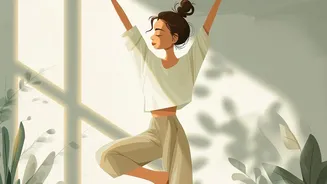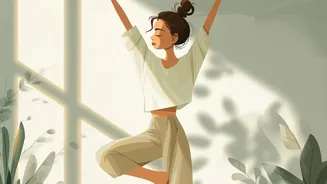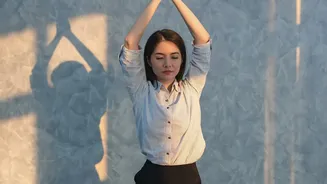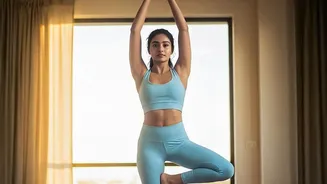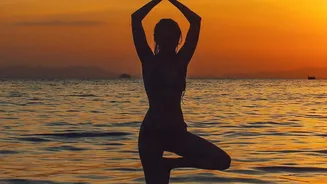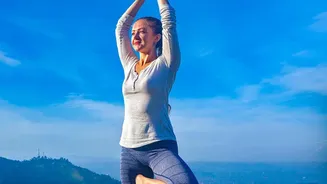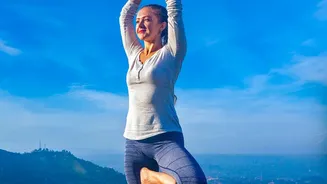




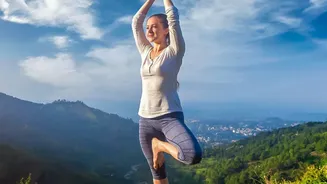
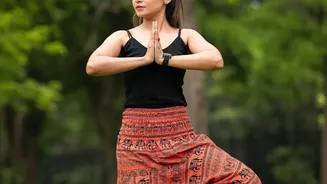
Feeling wobbly? The journey to better balance is both a physical and mental one, and few yoga poses capture this better than the elegant Tree Pose, or Vrikshasana. It’s a foundational posture that teaches you to stand tall, find focus, and grow steady.
Why You Should Practice Tree Pose
At its heart, Vrikshasana is a standing balance posture that offers a wealth of benefits beyond just helping you stay steady on one foot. Regular practice strengthens the muscles in your feet, ankles, and legs, creating a stable foundation. It also engages your core to keep your posture upright and aligned. Mentally, the pose is a powerful tool for improving concentration. Holding the posture requires you to fix your gaze on a single point (known as a 'drishti') and calm your mind, which can have a wonderfully grounding effect. It also gently opens the hips and stretches the inner thighs and groin.
How to Do the Basic Tree Pose
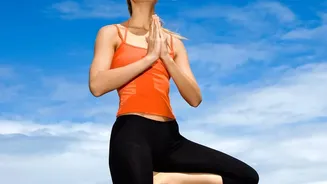
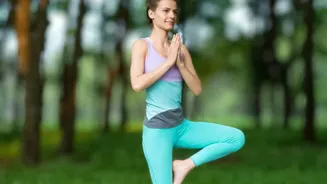
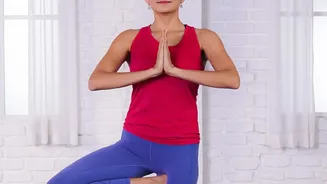
Start by standing in Mountain Pose (Tadasana), with your feet together or slightly apart, and your arms at your sides. Distribute your weight evenly and feel your connection to the ground. Shift your weight onto your left foot, engaging the leg muscles. Bend your right knee and use your hand to guide the sole of your right foot onto your inner left leg. You can place it on the ankle, calf, or inner thigh. The key is to press the foot firmly into the leg, and the leg back into the foot, creating a stable connection. Once you feel balanced, bring your hands together in a prayer position at your chest. If you feel steady, you can extend your arms overhead like branches. Hold for 20-60 seconds, breathing steadily, before gently releasing and repeating on the other side.
Common Mistakes to Avoid
One of the most critical rules of Tree Pose is to never place your foot directly on the knee joint of your standing leg. The knee is not designed to handle lateral pressure, and doing so risks injury. Always position your foot above or below the knee. Another common pitfall is letting the hip of the bent-leg side hike up. Aim to keep both hip points level and facing forward to maintain proper alignment. Also, avoid locking the knee of your standing leg; keep it strong but with a micro-bend to allow for small balance adjustments. Finally, remember to breathe. Holding your breath creates tension and makes balancing more difficult.
Beginner Variation: Use a Support
If you're new to balancing or just having a wobbly day, don't hesitate to use a support. Practicing near a wall is an excellent way to build confidence. You can lightly touch the wall with your hand for stability. Even just knowing it's there can help you relax into the pose. Another great option for beginners is to use a 'kickstand' modification. Simply keep the toes of your bent leg on the floor and rest your heel against the inner ankle of your standing leg. This gives you an extra point of contact with the ground, making the balance far more accessible while you build strength and focus.
Intermediate Variation: Change Your Branches
Once you feel stable in the basic pose, you can play with the position of your arms, or 'branches'. While hands at heart center (Anjali Mudra) or extended overhead are classic, there are other options. Try extending your arms out to the sides in a 'T' shape to challenge your stability in a different plane. You can also gently sway your arms overhead as if they are branches moving in a light breeze, which forces your core and standing leg to work harder to maintain your center of gravity. Each variation changes the dynamics of the pose, keeping your mind engaged and your body adapting.
Advanced Variation: Half_Lotus Tree
For a deeper hip_opening challenge, you can explore Ardha Padmasana, or Half_Lotus, in your Tree Pose. From a stable Tree, carefully bring the top of your lifted foot to rest on the opposite hip crease, with the sole of the foot facing upward. This variation requires significant hip flexibility, so it's important not to force it. Let the bent knee gently release downward over time. If you feel any pain in your knee, ease out of the pose immediately. This version intensely deepens the stretch in the hip and thigh and requires even greater focus to maintain balance.
Challenge Your Balance Further
Ready for the ultimate test of stability? Try closing your eyes. Our sense of balance relies heavily on visual cues, and removing them forces your body to depend entirely on proprioception—its internal sense of where it is in space. Start by trying it for just a second or two, perhaps near a wall for safety. Another way to increase the difficulty is to practice on a slightly unstable surface, like a folded yoga mat or a blanket. This makes your ankle and foot muscles work much harder to make constant microadjustments, significantly boosting their strength and your overall stability.