



The Promise of a New World
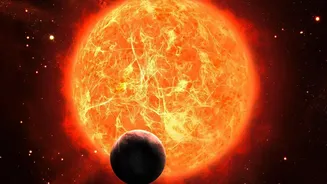
Located roughly 1,000 light-years from Earth, TOI-2535 b was first flagged as a potential planet in 2019 by NASA's Transiting Exoplanet Survey Satellite (TESS). TESS finds planets using the 'transit method', watching for tiny, periodic dips in a star's
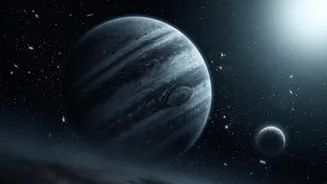
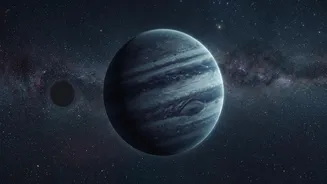
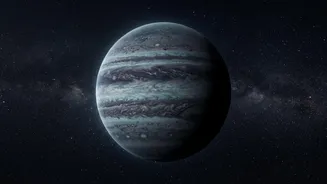
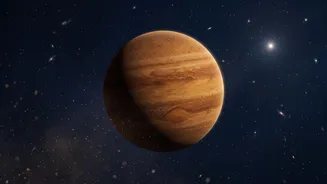
brightness caused by a planet passing in front of it. The data on TOI-2535 b pointed to a 'hot Jupiter'—a massive gas giant orbiting its star in a blisteringly fast 8.25 days. For years, astronomers watched its predictable transits, adding another fascinating world to our ever-growing cosmic catalogue. This was, by all accounts, a routine if exciting discovery that showcased the power of our planet-hunting technology.
A Cosmic Ghost Story
The story took a strange turn as observations continued. Astronomers noticed that the planet's orbital schedule was becoming erratic. Its transits started arriving up to six hours early or six hours late, a significant deviation for such a tightly orbiting world. Then, the dips in starlight became shorter and shallower. Finally, in March 2026, the transits stopped altogether. TOI-2535 b was no longer crossing the face of its star from our point of view. The planet, for all intents and purposes, had disappeared. This wasn't a case of a world being destroyed; it was something far more subtle and, in many ways, more interesting.
The Hidden Hand
The planet hadn't vanished into thin air. Researchers, led by a team from UCLA, concluded that TOI-2535 b was the victim of a gravitational tussle. The culprit is an unseen planetary neighbour. Just as the gravitational pull of our Moon creates tides on Earth, this hidden planet has been tugging on TOI-2535 b, causing its orbit to wobble like a spinning top. The interaction between the two planets is so strong that it gradually tilted TOI-2535 b’s orbital plane. Eventually, its orbit tilted so much that, from our perspective on Earth, it no longer passes in front of its star. It is still orbiting its sun, but its path is now hidden from our telescopes.
A Success, Not a Failure
A 'missing' planet might sound like a scientific failure, but the story of TOI-2535 b is the exact opposite. It's a testament to the rigour of the scientific method. The initial detection was correct, but the universe is more complex than a simple clockwork model suggests. These follow-up observations have revealed a dynamic, multi-planet system with powerful interactions. This event is one of the most extreme examples of planets influencing each other's orbits ever observed. It provides invaluable data on how planetary systems form and evolve, suggesting that some can be twisted into new alignments long after they first form. The mystery wasn't a dead end; it opened a new door of understanding.
The Next Chapter in the Search
While TOI-2535 b is out of sight for now, it is not gone forever. Scientists predict that its wobbly orbit will bring it back into our line of sight in about 30 to 50 years. In the meantime, the hunt is on for its mysterious companion, TOI-2535 c. By studying the precise nature of the wobble, astronomers can calculate the mass and orbit of this hidden world, even before they directly detect it. This continuing investigation highlights the global nature of modern astronomy, an endeavour where Indian scientists and institutions like ISRO also play a crucial role, contributing to our collective knowledge of the cosmos. The search for new worlds is not just about finding planets, but about understanding the intricate dance they perform around their stars.