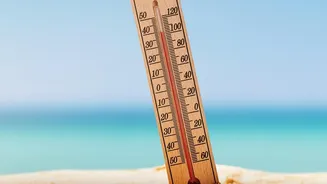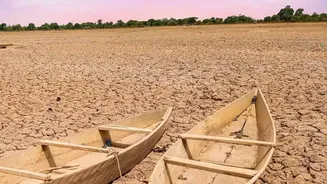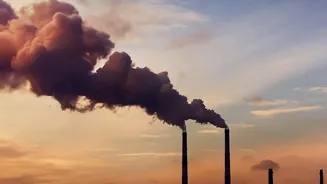






The global promise to limit warming to 1.5°C was a line in the sand to protect humanity from the worst of climate change. Recent assessments now show this critical guardrail is in jeopardy as international climate action fails to keep pace.
The 1.5°C Goal: A Planet's Lifeline
In 2015, under
the Paris Agreement, nations across the world committed to holding the increase in the global average temperature to well below 2°C above pre-industrial levels, while pursuing efforts to limit it to 1.5°C. This lower, more ambitious target was not arbitrary. Scientific bodies like the Intergovernmental Panel on Climate Change (IPCC) have shown that the difference between 1.5°C and 2°C of warming is substantial, representing a world of vastly different risks. For a country like India, a 1.5°C world is challenging, but a 2°C world could be catastrophic, worsening floods, droughts, and heatwaves, and threatening food production for millions. The goal is, therefore, a crucial benchmark for a liveable future, especially for vulnerable nations in the Global South.
The Sobering Reality: Ambition vs. Action
Recent reports paint a grim picture of global progress. The UN's 2026 Emissions Gap Report confirms that the opportunity to limit warming to 1.5°C with little to no 'overshoot' (a temporary period of exceeding the target) has now been lost. Projections show that even with current national pledges, known as Nationally Determined Contributions (NDCs), the world is on a trajectory for warming of 2.6°C or more. A late 2026 UNFCCC synthesis report on NDCs revealed that current commitments would only cut global emissions by about 6% below 2019 levels by 2035; a staggering shortfall from the 60% reduction science says is needed to stay on a 1.5°C pathway. This 'emissions gap' between where we are headed and where we need to be is widening, not closing, despite some progress in renewable energy expansion.
Why is Action Stalling?
The reasons for the slowdown are complex and multifaceted. A major barrier is the persistent gap in climate finance. Developing countries require substantial financial support for both mitigation (cutting emissions) and adaptation (preparing for impacts), but promises from developed nations have been slow to materialize and remain insufficient. While the initial USD 100 billion annual goal was technically exceeded in 2022-2024, critics point out it was years late and a fraction of the true need, with loans still dominating over grants. Furthermore, geopolitical instability and tightening national budgets are diverting attention and resources. While national climate plans are becoming more comprehensive, turning these plans into concrete, funded action on the ground remains a huge challenge, especially in sectors like transport, industry, and agriculture.
The Cost of Inaction for India
For India, exceeding the 1.5°C threshold is not an abstract concept. India is already warming faster than the global average and is highly vulnerable to climate impacts. A world that warms by $2$°C instead of $1$.$5$°C could expose tens of millions more people in India to lethal heatwaves and push millions into poverty by $2030$ due to impacts on agriculture and livelihoods. Sea-$level$ rise would be $0$.$1$ meters greater, threatening coastal cities like Mumbai and Kolkata far more severely. Water stress would intensify, and the risk of vector-$borne$ diseases like malaria would increase. The difference of half a degree, therefore, translates into a matter of survival and economic stability for a significant portion of the Indian population.
Is There Still a Path Forward?
While the prospect of overshooting $1$.$5$°C is now seen as unavoidable, experts stress this is not a reason for resignation but for greater urgency. The new goal is to limit the 'peak' of the overshoot and the duration spent above $1$.$5$°C. Returning to $1$.$5$°C by the end of the century is still considered possible, but it requires immediate, deep, and sustained cuts in greenhouse gas emissions across all sectors. This means tripling renewable energy capacity, rapidly phasing out fossil fuels, and halting deforestation. It will also necessitate the use of carbon dioxide removal technologies, though their large -scale feasibility remains uncertain. The upcoming COP$31$ climate conference in Antalya, Türkiye, is a critical moment for governments to radically increase their ambition and deliver the finance and cooperation needed to turn the tide.