




The Scientific Breakthrough: What Are 'Analogue' Black Holes?
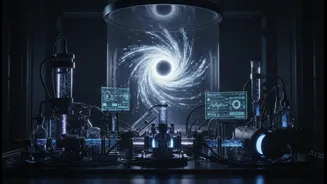
First, let's be clear: scientists have not created a miniature, planet-eating black hole. Instead, they have built 'analogue' or 'model' black holes. These are systems that use other physical phenomena, like sound waves in a fluid or light in an optical
fiber, to mimic the properties of a gravitational black hole. One of the most famous predictions about black holes came from Stephen Hawking in 1974, who theorized that they aren't truly 'black' but should emit a faint glow of particles, now known as Hawking radiation. Since the radiation from actual cosmic black holes is thought to be too faint for our current instruments to detect, these lab-based analogues offer a revolutionary way to study such predictions. Researchers have created these analogues in various ways. One method involves using a super-cooled fluid called a Bose-Einstein condensate and creating a region where the fluid flows faster than the speed of sound. This creates a 'sonic event horizon'—a point of no return for sound waves (phonons), much like a gravitational event horizon traps light.
Decoding the 'Energy' Comparison
The headline's mention of "energy" relates to two key concepts. The first is Hawking radiation itself, which is a form of energy predicted to escape the black hole. By observing this phenomenon in lab analogues, scientists are confirming a fundamental process of energy release from what was once thought to be an inescapable object. Recent experiments in early July 2026 have taken this a step further. Researchers at CUNY's Advanced Science Research Center successfully demonstrated a theory proposed by Sir Roger Penrose in 1969. Penrose suggested energy could be extracted from a spinning black hole. The CUNY team built a stationary device using special metamaterials that mimicked the effects of an object rotating at impossible speeds. They found that radio waves bounced off this synthetically rotating system emerged with more energy, effectively drawing power from the rotation itself in a process called superradiance. This lab-based confirmation of energy extraction opens a new chapter in experimental physics.
The Practical Impact: Beyond Pure Physics
While the immediate goal is to verify theories of fundamental physics, the technologies being developed have tangible, real-world potential. The recent CUNY experiment, which amplifies waves by extracting energy from synthetic rotation, could have major implications for telecommunications, optics, and quantum computing. This form of selective amplification could lead to more sensitive receivers and new ways to manipulate waves. Another practical application stems from the study of 'sonic black holes' for acoustic engineering. The same principles used to trap sound in lab experiments can be applied to create highly effective sound-absorbing materials. These 'acoustic black holes' could lead to ultra-quiet environments in everything from duct systems to naval ships by providing near-perfect absorption of unwanted noise and vibrations. This technology is being explored for creating compact, broadband mufflers that outperform traditional designs, particularly at low frequencies.
Remaining Questions and the Road Ahead
Despite these successes, major questions remain. A primary debate in the scientific community is whether confirmation in an analogue system truly proves the phenomenon exists in a real, gravitational black hole. Since the experiments must assume the underlying physical models are correct, some argue it's not a definitive confirmation for astrophysics. However, others maintain that these experiments are of tremendous importance, as direct observation of Hawking radiation from a cosmic black hole is currently impossible. Furthermore, the experiments themselves often yield surprising results. Some have detected stronger or weaker radiation than predicted, pushing theorists to refine their models. The biggest unanswered question in physics remains how to unify gravity with quantum mechanics. Analogue gravity experiments, by allowing researchers to probe the boundary where these theories intersect, provide a crucial and accessible testbed for new ideas that might one day lead to a complete 'theory of everything'.