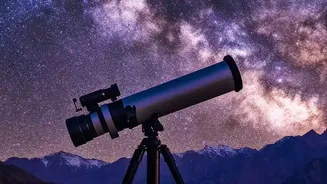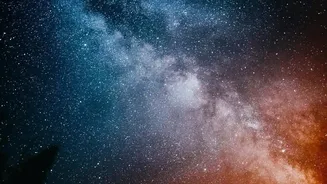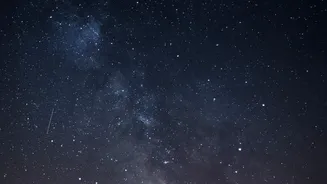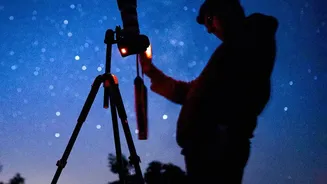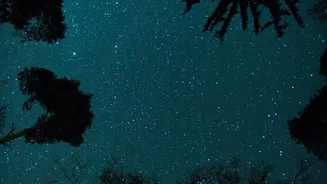





Have you ever looked up at the night sky from a city and wondered where all the stars went? A handful of bright dots are all that remain of the billions that once filled our ancestors' skies. The magic, however, is not lost, just hidden.
The Enemy of Starlight: What is Light Pollution?
The culprit behind
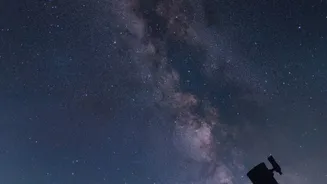
our disappearing stars is light pollution, the excessive and misdirected use of artificial light at night. It comes from streetlights, glowing office buildings, and bright advertising hoardings that cast a luminous haze into the atmosphere. This phenomenon, known as 'skyglow', acts like a blanket, washing out the night sky and reducing the contrast needed to see fainter celestial objects. More than 80% of the world's population now lives under light-polluted skies, making the Milky Way, our own galaxy, a rare sight for millions. For astronomers and hobbyists, this means faint nebulae and distant galaxies are rendered invisible, and even bright constellations become harder to trace. It's not just an aesthetic loss; light pollution also disrupts nocturnal ecosystems and can affect human health. Protecting our dark skies is about preserving a connection to the universe that has inspired humanity for millennia.
Hanle, Ladakh: India’s Dark Sky Sanctuary
Deep in the Changthang plateau of Ladakh, at an altitude of 4,500 metres, lies Hanle—the crown jewel of Indian stargazing. Officially designated as India's first Dark Sky Reserve in 2022, this remote region is a protected zone where artificial lighting is carefully controlled to preserve the pristine night sky. Home to the Indian Astronomical Observatory, one of the world's highest, Hanle benefits from over 250 clear nights a year, thin air, and almost non-existent light pollution. On a moonless night here, the Milky Way stretches from horizon to horizon with such clarity that its dark dust lanes are visible to the naked eye. The journey from Leh is long, typically 7-8 hours, and requires permits, but the reward is a celestial view that is among the best in Asia.
Spiti Valley, Himachal Pradesh: A High-Altitude Haven
Spiti Valley, a cold desert mountain valley high in the Himalayas, is another paradise for stargazers. With an average elevation of over 12,500 feet, its dry, crisp mountain air and remote location ensure some of the darkest skies on the planet. Villages like Langza, Komic, and Kibber are renowned spots where the lack of urban glow allows the cosmos to unfold in breathtaking detail. On a clear night, the sky is a dense tapestry of stars, planets, and meteor showers. The Milky Way is so brilliant here that it is said to cast a faint shadow on the ground. The best time to visit for stargazing is from May to October, when the roads are open and the skies are reliably clear after the summer dust has settled. A trip to Spiti offers not just a view of the universe, but an immersive cultural experience in its ancient monasteries and homestays.
Rann of Kutch, Gujarat: The White Desert Sky
For a truly unique stargazing experience, look no further than the Great Rann of Kutch in Gujarat. This vast salt desert offers a surreal landscape and an unobstructed, 360-degree view of the heavens. Far from major cities, its skies are incredibly dark, especially during the cool, dry winter months from November to February, which coincides with the popular Rann Utsav festival. The flat, featureless horizon makes it feel like you are standing at the centre of a celestial dome. During a new moon, the Milky Way is spectacular against the inky black sky. Even on a full moon night, the experience is magical, as the white salt flats reflect the moonlight, creating an ethereal glow that illuminates the landscape without washing out the brightest stars.
Coorg,' Karnataka': The Southern Star Field
While '>'the Himalayas boast high-'altitude' clarity,'the Western Ghats offer their own charm.'Coorg,' or Kodagu,' in Karnataka provides one of southern India's best accessible dark sky experiences.'Nestled amidst coffee and spice plantations,'the region's higher elevations and sparse population in areas like '>'the Brahmagiri foothills offer surprisingly dark skies.'The best viewing season is from November through May,'after '>'the monsoons have cleared '>'the atmosphere.'While '>'the glow from towns like Madikeri can be an issue,'venturing into '>'the southern valleys reveals skies dark enough to view '>'the Milky Way on moonless nights,'particularly between February and May.'Several homestays and observatories now cater to astro-'tourists,'offering guided sessions with telescopes.
Neil Island,' Andaman and Nicobar:' Coastal Constellations
Stargazing from a tropical beach is a different kind of magic.'The Andaman and Nicobar Islands,'thanks to their remote location in '>'the Bay of Bengal,'offer splendid night skies with minimal light pollution.'Neil Island (Shaheed Dweep) is particularly known for its tranquil beaches and clear skies.'Away from '>'the relatively brighter Port Blair,'the darkness over '>'the open ocean creates a perfect backdrop for celestial observation.'The best time to visit is during '>'the dry season from November to March,'when '>'the skies are free of monsoon clouds.'Lying on a quiet beach like Laxmanpur or Sitapur,'with '>'the sound of waves in your ears and a canopy of stars overhead,'is an unforgettable experience.