




What Is the Golden Coffee Ratio?
The 'Golden Ratio' refers to the ideal proportion of coffee grounds to water for a balanced extraction. While there isn't one single number that works for every person and every bean, the range provides a powerful starting point. The Specialty Coffee
Association (SCA) established a 'Golden Cup Standard' which suggests a ratio of 55 grams of coffee per litre of water. This translates to a coffee-to-water ratio of approximately 1:18, meaning 1 gram of coffee for every 18 grams (or millilitres) of water. However, many baristas and home brewers find their sweet spot in a slightly stronger range, typically between 1:15 and 1:17. Think of it not as a rigid rule, but as a reliable guideline to save you from weak, sour, or overly bitter coffee.
Why This Ratio Is Your Secret Weapon
Brewing coffee is a process of extraction—dissolving flavour compounds from the grounds into water. This process happens in stages: first acids (brightness), then sugars (sweetness), and finally more bitter compounds. The coffee-to-water ratio is your primary tool for controlling the final strength and balance of these flavours. If you use too much water for the amount of coffee (a high ratio like 1:20), you risk under-extraction; the brew will taste weak, sour, and underdeveloped because you didn't pull out enough of the good stuff. If you use too little water (a low ratio like 1:12), you risk over-extraction; the water pulls too many compounds, including the unpleasant bitter ones, resulting in a harsh, drying taste. The golden ratio helps you land squarely in that 'sweet spot' where the coffee is balanced and flavourful.
Getting Started: Your Most Important Tool
To accurately use a brew ratio, you need to weigh your ingredients. This is where a simple kitchen scale becomes the most valuable tool in your coffee arsenal. Why weigh instead of using scoops? Coffee beans vary in size and density depending on the roast level; a scoop of a dark, oily roast can weigh significantly less than the same scoop of a light, dense roast. Weighing in grams ensures you are using the exact same amount of coffee and water every single time, making your results repeatable. If you want a 1:16 ratio for a single cup, you can weigh out 20 grams of coffee and use 320 grams of water (since 1ml of water weighs 1 gram). This precision is the foundation of consistency.
Adapting the Ratio for Your Brewer
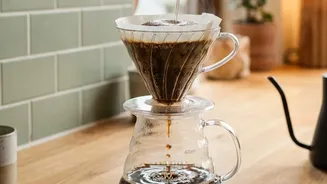
While 1:16 is a fantastic all-purpose starting point, different brewing methods benefit from slight adjustments. This is because methods like immersion (French press) and percolation (pour-over) extract coffee differently. Here are some trusted starting points: Pour-Over (V60, Drip Machines): Start with a 1:16 or 1:17 ratio. This method highlights clarity and brightness, and this ratio prevents the cup from tasting too thin. For a standard 320g cup, use 20g of coffee. French Press (Immersion): Because the grounds steep directly in water for several minutes, extraction is very efficient. A slightly tighter ratio of 1:14 or 1:15 often works best, producing a rich, full-bodied cup without excessive bitterness. Cold Brew: Cold brew requires a much more concentrated ratio because cold water is a less efficient solvent than hot water. For a concentrate that you'll dilute later, start with a ratio anywhere from 1:4 to 1:8. For a ready-to-drink version, a 1:12 to 1:15 ratio is more appropriate.
Fine-Tuning for Your Perfect Cup
The Golden Ratio is your baseline, not your destination. Once you've brewed a cup using a standard ratio like 1:16, taste it and decide how you want to adjust. Is it a little too intense? Widen the ratio to 1:17 for a lighter-bodied cup. Wish it had a bit more punch? Tighten the ratio to 1:15 for a stronger brew. Remember to only change one variable at a time. If you change both your ratio and your grind size, you won't know which one was responsible for the change in taste. Use the ratio to control strength and then adjust your grind size—finer for more extraction, coarser for less—to dial in the flavour balance. Water temperature is also key, with the ideal range being between 91-96°C (195-205°F) for most methods.