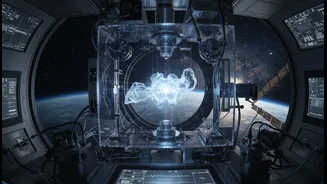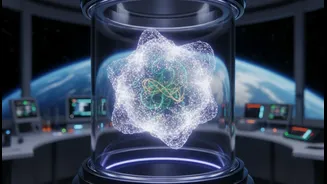





What Is the Cold Atom Lab?
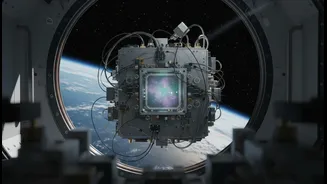
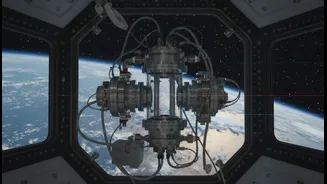
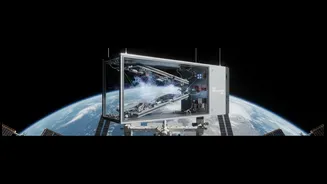
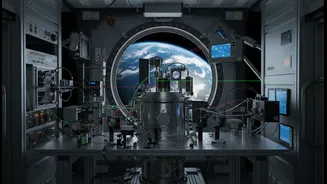
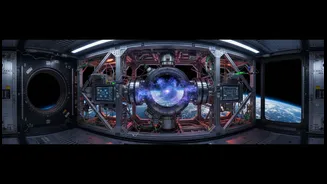
Since its installation in 2018, NASA's Cold Atom Lab (CAL) has been a unique physics facility aboard the International Space Station. Its primary mission is to create and study a fifth state of matter called a Bose-Einstein Condensate (BEC). To do this,
lasers and magnetic fields are used to cool atoms to temperatures just a fraction of a degree above absolute zero—colder than any natural environment in the universe. On Earth, gravity quickly pulls these ultracold atoms down, limiting observation times. But in the microgravity of the ISS, scientists can study these BECs for much longer, from five to 10 seconds, allowing them to observe quantum phenomena on a macroscopic scale. Remotely operated from Earth, the lab has received several upgrades since 2018, most recently in 2026, enhancing its capabilities.
The Quantum Leap in Navigation
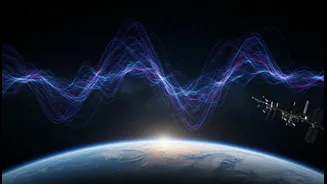
One of the most exciting potential applications of the CAL's research is in quantum navigation. The goal is to create inertial navigation systems that do not rely on external signals, like those from GPS satellites. This would be revolutionary for submarines, deep-space probes, or even autonomous vehicles in areas without satellite coverage. The technology relies on a technique called atom interferometry. By splitting and recombining waves of ultracold atoms, these sensors can measure acceleration and rotation with extreme precision. Because the properties of atoms are constant and don't drift over time, these quantum accelerometers could provide pinpoint accuracy indefinitely. The CAL has successfully demonstrated the principles of atom interferometry in space, a critical first step toward making this technology a reality.
Redefining Gravity and Fundamental Physics
Beyond navigation, the Cold Atom Lab serves as a powerful tool for fundamental physics research. The extreme precision offered by atom interferometry allows for incredibly sensitive measurements of gravity. Future, more advanced versions of these sensors could map Earth's gravity field to track the movement of water and changes in ice sheets with unprecedented detail. Furthermore, the CAL provides a unique environment to test Albert Einstein's theory of general relativity and search for elusive phenomena like dark energy. By observing how atoms behave in their purest quantum state, free from the dominant influence of Earth's gravity, scientists can hunt for tiny deviations that might point to new physics.
From Laboratory Promise to Deployed Systems
Herein lies the critical distinction. The Cold Atom Lab is a room-sized laboratory shrunk down to a mini-fridge, a remarkable engineering feat, but it remains a highly complex, power-intensive research facility. A quantum sensor deployed in a submarine or spacecraft must be small, rugged, low-power, and operate flawlessly for years without astronaut intervention. Current quantum sensing equipment often requires an entire room and extreme environmental controls to function. While researchers are making progress with technologies like photonic integrated circuits to miniaturize these components, the gap between a successful lab experiment and a field-ready device is vast. The CAL is an indispensable testbed, proving the physics works in space, but it is not a prototype of a deployed sensor.