







An Atmosphere on a Lava World
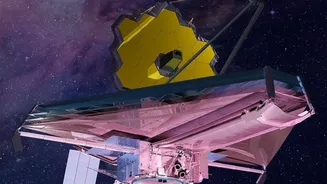
In a major breakthrough, astronomers using the JWST have confirmed a substantial atmosphere blanketing 55 Cancri e, a super-Earth located 41 light-years away. This isn't a gentle, Earth-like world; it's a hellish planet where surface temperatures are
hot enough to melt rock. The planet orbits its star in a blistering 18 hours, creating a world likely covered by a bubbling ocean of magma. For years, scientists debated whether a planet so close to its star could hold onto any atmosphere at all. Many assumed it would be a bare rock, stripped clean by intense stellar radiation. Instead, JWST’s data revealed that the planet’s dayside was significantly cooler than expected, a clear sign that a thick atmosphere is present and distributing heat around the planet.
A World Breathing Out Gases
So, what is this alien atmosphere made of? The data points not to vaporised rock, as some theories suggested, but to a thick envelope of gas rich in carbon monoxide or carbon dioxide. Scientists believe this is a 'secondary' atmosphere, meaning the original one was blasted away long ago. The current atmosphere is thought to be continuously replenished by gases bubbling out from the planet-wide magma ocean. While this scorching world is completely uninhabitable, the discovery is monumental. It proves that a rocky planet, even under extreme conditions, can sustain a significant atmosphere. This offers hope that planets in more temperate zones might be even better at holding onto the gases needed to support life.
The Tantalising Hint of Water
While 55 Cancri e provided evidence of a thick, carbon-rich atmosphere, another super-Earth has presented a different kind of puzzle. Observations of GJ 486 b, a rocky planet 26 light-years away, revealed intriguing hints of water vapour. Using a technique called transit spectroscopy, where the telescope analyses starlight filtering through a planet's atmosphere, scientists detected a signal that was a close match for water. If confirmed, it would be a landmark discovery of a water-rich atmosphere on a rocky world. However, there's a significant catch that has researchers exercising caution.
A Planet's Atmosphere or a Star's Deception?
The puzzle with GJ 486 b is that scientists cannot yet be sure if the water vapour is from the planet or from its host star. The planet orbits a cool red dwarf star, and these types of stars can have water vapour in their own cool spots, known as starspots. This stellar water could create a signal that perfectly mimics a planetary atmosphere, making it incredibly difficult to distinguish between the two possibilities with current data. Scientists have emphasised that even if the planet does have a steamy atmosphere, it is far too hot for life, with a surface temperature around 430 degrees Celsius. Further observations will be needed to solve this cosmic mystery.
Why These Discoveries Matter
Neither 55 Cancri e nor GJ 486 b are habitable new Earths. But their study is a critical step towards finding one. The confirmation of an atmosphere on 55 Cancri e demonstrates that JWST has the power to characterise the atmospheres of rocky worlds, a key capability that was previously beyond our reach. Studying this magma ocean world can provide a unique window into the early history of planets like Earth, Venus, and Mars, which are all thought to have been covered in molten rock in their distant past. These findings, both the confirmation on one world and the watery question on another, push the boundaries of science and refine the tools astronomers will use to eventually analyse a truly Earth-like planet. The search for life elsewhere in the galaxy just took a giant leap forward.