






The Problem with Uranium
Uranium is a naturally occurring element, but human activities like mining and the use of nuclear technologies have led to its increased concentration in the environment. When uranium is in its soluble form, known as hexavalent uranium or U(VI), it dissolves
easily in water. This allows it to travel through groundwater, contaminating vast water resources far from the original source. In India, studies have found widespread uranium contamination in the groundwater of numerous states, posing a significant risk to public health. Exposure to uranium in drinking water has been linked to serious health issues, including chronic kidney disease.
Nature's Cleanup Crew
Enter the world of microbial bioremediation. This process uses living organisms, primarily bacteria, to clean up pollutants. For decades, scientists have been studying bacteria that can interact with heavy metals. Certain types of bacteria, such as Geobacter and Shewanella, have a remarkable ability. In oxygen-free environments, they can essentially 'breathe' uranium. Through their metabolic processes, these microbes add electrons to the soluble U(VI), converting it into insoluble tetravalent uranium, or U(IV). This solid form, called uraninite, precipitates out of the water, effectively immobilizing the contaminant and preventing it from spreading.
The Power of a Biofilm
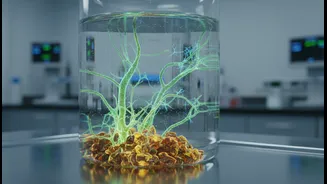
The real power of these bacteria is amplified when they work together in communities called biofilms. A biofilm is a protected environment where bacteria can thrive, even in the presence of high concentrations of toxic substances like uranium. Research shows that Geobacter biofilms are substantially more effective at immobilizing uranium than individual planktonic cells. The biofilm's matrix acts as a shield, protecting the cells from uranium's toxicity while its conductive 'pili'—tiny wire-like appendages—work to reduce the uranium extracellularly. This prevents the toxic metal from entering and damaging the bacterial cells, allowing them to continue their cleanup work for longer periods.
A More Stable Solution
A recent breakthrough has added another exciting chapter to this story. Scientists discovered that when a natural community of bacteria from a flooded uranium mine was given glycerol as a food source, they not only removed nearly all the dissolved uranium but converted it into a surprisingly stable compound. Instead of just reducing uranium to U(IV), which can sometimes re-oxidize and become soluble again, the bacteria helped form a highly stable pentavalent uranium, or U(V), mineral. This compound demonstrated remarkable resistance to re-oxidation, even when exposed to oxygen, suggesting it could be a more permanent solution for long-term storage of the contaminant.
What This Means for India
With significant uranium contamination detected in groundwater across states like Rajasthan and Gujarat, and concerns raised near mining operations, this technology holds immense promise for India. Traditional cleanup methods are often expensive and can produce their own hazardous by-products. Bioremediation offers a potentially cheaper, eco-friendly alternative. By stimulating the growth of these native, uranium-fixing bacteria at contaminated sites—perhaps by simply adding a nutrient source like glycerol—it might be possible to create natural, self-sustaining barriers that lock away uranium pollution where it is.