






An Unblinking Eye at Lagrange Point 1
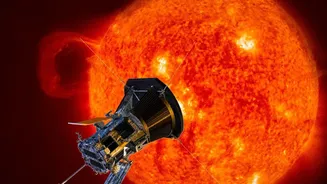
To effectively watch a star that never sleeps, you need a vantage point with no interruptions. That is the genius behind Aditya-L1's location. The spacecraft is positioned in a halo orbit around the first Sun-Earth Lagrange Point (L1). At this specific
spot, the gravitational pulls of the Sun and Earth balance each other out, allowing the probe to essentially hover between them. This gives it a continuous, unobstructed view of the Sun, free from the cycles of day and night or the interference of Earth's atmosphere and magnetic field that hinder ground-based observations. This constant watch is critical, as solar storms can develop and race toward Earth in a matter of hours. The L1 position gives scientists a crucial head start, providing data on solar events long before their effects are felt on our planet.
The Tools for Decoding Solar Secrets
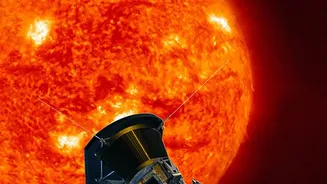
Aditya-L1 is not just one instrument, but a full-fledged solar observatory packed with seven sophisticated payloads, each designed to answer fundamental questions about our star. Four of these are remote-sensing instruments that 'look' at the Sun, while three are in-situ instruments that 'feel' the space environment around the spacecraft. The Visible Emission Line Coronagraph (VELC) is a primary payload, designed to study the Sun's outer atmosphere, the corona, where violent events like Coronal Mass Ejections (CMEs) originate. Other instruments like the Solar Ultraviolet Imaging Telescope (SUIT) and X-ray spectrometers (SoLEXS and HEL1OS) provide a multi-wavelength view, tracking energy as it moves from the Sun's surface to its superheated corona. Meanwhile, particle analysers like ASPEX and PAPA, along with a Magnetometer (MAG), directly sample the solar wind—the stream of charged particles and magnetic fields flowing from the Sun. This combination allows scientists to connect an event on the Sun's surface with the material that eventually sweeps past the spacecraft.
From Raw Data to Early Warnings
The mission's data is already deepening our understanding of how solar storms impact Earth. In a recent study, ISRO scientists used Aditya-L1 observations to analyse a powerful storm that hit our planet. They found that the most severe effects were linked to a turbulent region within the storm that the spacecraft helped identify. This turbulence strongly compressed Earth's magnetic shield, pushing it dangerously close to our planet and exposing some geostationary satellites to harsh conditions. By directly measuring the properties of the solar wind and CMEs as they head towards us, Aditya-L1 provides the raw data needed to forecast not just the arrival of a storm, but its intensity and potential impact. This gives grid operators, satellite controllers, and airlines crucial time to take protective measures, such as powering down sensitive equipment or rerouting flights.
Solving the Sun's Greatest Mysteries
Beyond just storm prediction, Aditya-L1's data is helping to solve longstanding puzzles about the Sun itself. One of the biggest is the 'coronal heating problem': why the Sun's atmosphere is millions of degrees hotter than its surface. Recent findings from the mission, published in the Astrophysical Journal Letters, suggest that the constant reconfiguration of the Sun's magnetic fields may provide the vast majority of the energy required to keep the corona so hot. This process of magnetic reconnection is also the engine behind solar flares and CMEs. By understanding the fundamental physics of how the Sun heats its own atmosphere and releases energy, scientists can build more accurate models of space weather. These insights transform storm prediction from a reactive process into a proactive one, based on a deeper knowledge of the Sun's behaviour.