




Let's Do the Bizarre Math
First, let's get the mind-bending numbers straight. A year is defined by how long it takes a planet to complete one orbit around its star. For Venus, this journey takes about 225 Earth days. Simple enough. But a day—the time it takes for a planet to complete one full
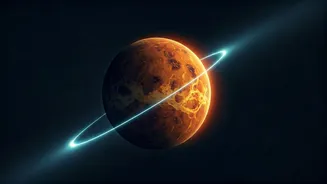
rotation on its axis—is where things get weird. Venus spins so incredibly slowly that one full rotation, what astronomers call a sidereal day, takes about 243 Earth days. That’s right: it takes longer for Venus to spin once on its axis than it does for it to complete a full trip around the Sun. You would literally finish a year before you finish a day. It’s a concept that breaks our Earth-centric understanding of time, where we experience roughly 365 days in every year. On Venus, you get less than one day per year.
The Slow, Backward Spin
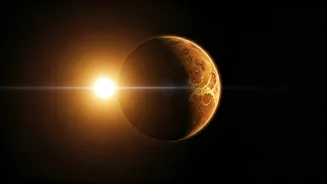
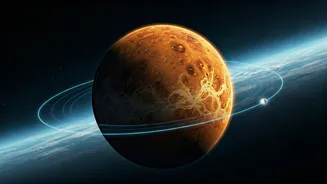
So, what causes this celestial traffic jam? The culprit is Venus’s bizarre rotation. Not only is it the slowest rotation of any planet in our solar system, but it also spins backward. While Earth and most other planets rotate counter-clockwise on their axes, Venus spins clockwise in a process known as retrograde rotation. If you could stand on the surface of Venus (which you can’t, but we’ll get to that), the Sun would appear to rise in the west and set in the east. Scientists aren’t entirely sure why Venus is the solar system’s oddball spinner. The leading theory is that it was struck by a massive asteroid or other celestial body early in its history, which either dramatically slowed its rotation and reversed its direction or knocked it completely upside down. Another theory suggests that the planet's incredibly thick, heavy atmosphere created so much friction and tidal pull on the surface over billions of years that it gradually ground the planet’s spin to a near-halt and then slowly reversed it.
A Day vs. a 'Solar Day'
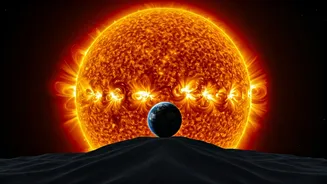
Here’s where it gets even stranger. While a rotational (sidereal) day is 243 Earth days long, the time from one sunrise to the next—what we’d experience as a day-night cycle, or a 'solar day'—is much shorter. Because the planet is rotating backward while it orbits the Sun, the time between sunrises is about 117 Earth days. This means you’d have roughly two sunrises per Venusian year. Imagine a day where the sun slowly crawls across the sky for nearly two months, followed by two months of night. It’s a rhythm completely alien to our own, where the sun’s movement is a reliable, daily metronome. This difference between the rotational day and the solar day is a direct consequence of the planet's slow, backward spin interacting with its relatively fast orbit around the Sun.
What a Day on Venus Is Really Like
Even if you could survive the strange timekeeping, a day on Venus would be anything but pleasant. Often called Earth’s 'evil twin,' Venus is a vision of a runaway greenhouse effect. Its atmosphere, about 90 times thicker than Earth's, is composed almost entirely of carbon dioxide. This traps heat so effectively that surface temperatures hover around a staggering 870°F (465°C)—hot enough to melt lead. The atmospheric pressure is equivalent to being 3,000 feet underwater in Earth’s oceans. To top it off, the sky is perpetually overcast with thick clouds of sulfuric acid. So while the idea of a day lasting longer than a year is a fascinating astronomical quirk, the reality is a crushing, scorching, toxic environment. There is no leisurely watching the sun rise in the west; there is only a dim, orange-hued glow filtering through a poisonous sky.