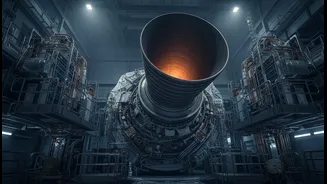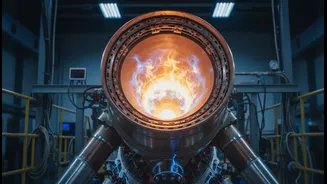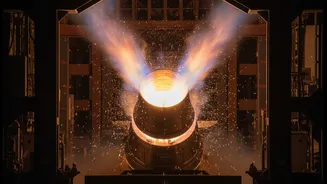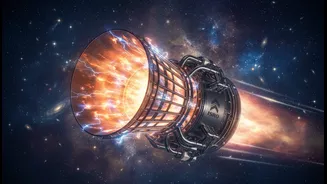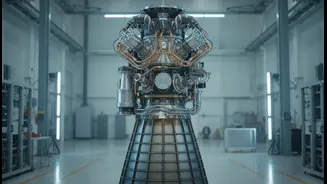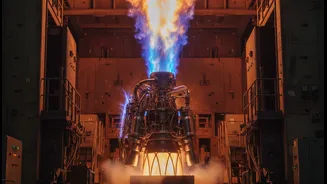




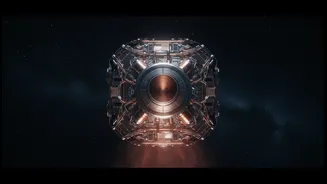
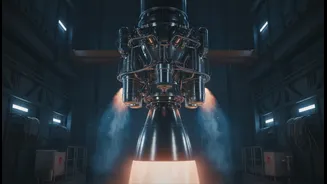
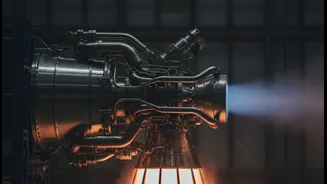


First, What Is a Semicryogenic Engine?
Think of rocket engines as needing two things to work: a fuel and an oxidiser (to help the fuel burn in space). A fully cryogenic engine uses super-cooled liquid hydrogen as fuel and liquid oxygen as the oxidiser. They are powerful but complex and expensive,
as liquid hydrogen is difficult to store at its required temperature of -253°C. A semicryogenic engine, like ISRO's new SE2000, simplifies things. It still uses liquid oxygen as the oxidiser but swaps the fuel for a highly refined form of kerosene, sometimes called Isrosene. This kerosene doesn't need to be kept extremely cold, making the engine system cheaper, easier to handle, and less bulky.
More Power, Heavier Lifts
The immediate impact of the SE2000 engine is a significant boost in power. Designed to produce 2,000 kilonewtons (kN) of thrust, it is one of the most powerful engines ISRO has ever developed. This engine is slated to replace the current core stage of India's heaviest rocket, the Launch Vehicle Mark-3 (LVM3). This upgrade will increase the LVM3's payload capacity, allowing it to lift heavier satellites into orbit. Specifically, its capacity to carry satellites to Geostationary Transfer Orbit (GTO) is expected to increase from 4 tonnes to 5 tonnes. This means India will no longer need to rely on foreign launch services for its heaviest communication satellites, enhancing its strategic autonomy in space.
The Path to Cheaper Launches
One of the most significant long-term impacts is cost reduction. Kerosene is significantly cheaper and easier to handle than liquid hydrogen. This simplifies launch preparations and reduces the overall cost per launch. More importantly, this technology is a critical stepping stone towards developing reusable launch vehicles (RLVs), similar to those operated by SpaceX. The ability to reuse the most expensive parts of a rocket, like its first-stage engines, can dramatically bring down the cost of accessing space. ISRO is actively working on its RLV technology demonstration program, and this powerful, more robust engine is a key piece of that puzzle.
Powering the Next Generation
The SE2000 engine is not just an upgrade; it's the foundation for the future. It is the designated powerhouse for ISRO’s upcoming Next Generation Launch Vehicle (NGLV). The NGLV, also known as 'Soorya', is envisioned as a modular and reusable rocket family designed to replace the workhorse PSLV and GSLV rockets, streamlining India's launch capabilities. By developing a powerful, cost-effective, and potentially reusable engine now, ISRO is laying the groundwork for a vehicle that will serve India's space needs for decades to come, from launching commercial satellites to enabling ambitious deep-space missions and the Bharatiya Antariksh Station (Indian Space Station).
Boosting India's Global Standing
Mastering semicryogenic technology places India in an elite club of nations with this capability. As the global space economy grows, having a cost-effective and powerful launch system is crucial for capturing a larger share of the commercial launch market. Currently, India holds about 2% of this market, with ambitions to increase it to 10% by 2030. Cheaper, more powerful launches made possible by the SE2000 will make ISRO a more attractive option for international clients looking to send their satellites to space. This not only brings in revenue but also elevates India's status as a major player in the global space community, ready for more complex missions, including human spaceflight and interplanetary exploration.