







The Silent Ageing Inside Our Muscles
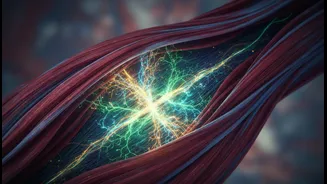
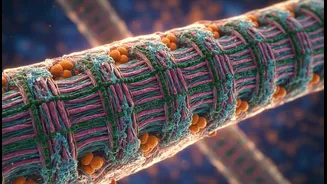
Long before we see wrinkles or grey hair, our bodies are ageing on the inside. This is known as molecular or cellular ageing. Inside each of our muscle cells, a complex balancing act is taking place. As we get older, this balance can tip. The processes
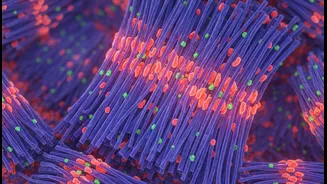
that clear out damaged components and repair cellular structures can slow down. Studies have shown that from around age 30, muscle mass can decrease by 3-8% each decade, a decline that speeds up after 60. This isn't just about losing strength; it's a sign of accumulating cellular wear and tear, including declines in the function of mitochondria, the 'powerhouses' of our cells.
What is Multi-Omics Analysis?
This is where the science gets really exciting, but the name can be intimidating. Think of your body as a massive, bustling city. A single snapshot from a satellite (like looking at your genes, or 'genomics') tells you part of the story. But what if you could also see the traffic flow (proteins, or 'proteomics'), the power grid usage (metabolites, or 'metabolomics'), and the zoning laws (epigenomics) all at the same time? That's what multi-omics analysis does. It’s an approach that combines data from multiple biological layers—the genome, proteome, transcriptome, and more—to create a complete, holistic picture of what’s happening inside a cell or tissue at any given moment. This powerful method allows scientists to see the complex interactions and understand biological processes more deeply than ever before.
Exercise: The Ultimate Cellular Tune-Up
So, what does this high-tech analysis tell us about exercise? Multi-omics studies are revealing that physical activity acts like a master switch for our cellular health. A recent wave of research, including large-scale projects like the Molecular Transducers of Physical Activity Consortium (MoTrPAC), uses these techniques to map the precise molecular changes that happen when we exercise. One key finding is that exercise helps restore balance. For example, as we age, a factor called DEAF1 can increase in muscles, disrupting the cell's ability to clean house and repair itself. Studies show that exercise activates other genes that act as a brake on DEAF1, allowing the muscle to get back to the crucial work of clearing out damage and staying healthy.
More Than Just Muscle Growth
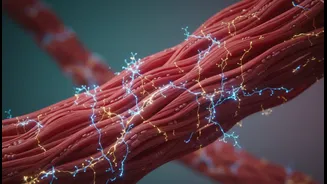
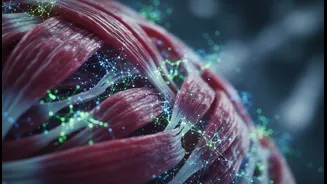
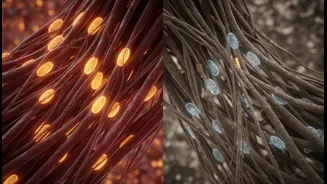
The benefits uncovered by this research go far beyond just building bigger muscles. Exercise, particularly resistance training, has been shown to fundamentally rejuvenate muscle tissue at the molecular level. In one study, after six months of resistance training, the genetic fingerprint of muscle tissue in older adults was remarkably reversed to a state similar to that of younger people. These molecular signals don't just stay in the muscle. Active muscles release thousands of molecules known as 'myokines' that can travel throughout the body and reduce markers of cellular ageing and inflammation everywhere, from fat tissue to the liver and even the brain. It's a full-body anti-ageing effect, all kicked off by a workout.
It's Never Too Late to Start
Perhaps the most encouraging message from this advanced science is a simple one: it’s never too late to benefit. Studies confirm that even in older muscle, the protective pathways activated by exercise can still be switched on. Research has shown that even multi-week exercise programs can reduce markers of biological age in the blood and muscle. Whether it's endurance exercise like jogging or resistance exercise like lifting weights, both trigger a cascade of positive molecular changes. The science of multi-omics is simply giving us a clearer, more detailed map of a truth we've long known—that an active lifestyle is a cornerstone of healthy ageing.