







A Hero Stumbles
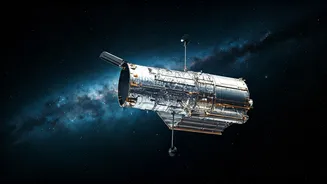
For over 34 years, the Hubble Space Telescope has been humanity's most productive window to the cosmos, delivering breathtaking images and world-changing science. But even heroes have their limits. Recently, the telescope began showing its age when one
of its critical pointing devices, a gyroscope, started malfunctioning. Think of gyroscopes as the telescope's inner ear; they measure how fast it's turning, allowing it to point with incredible precision at distant stars and galaxies. Normally, Hubble uses three gyros for maximum efficiency. After a servicing mission in 2009, it had six new ones, but over the years, they've failed one by one. When one of the last three remaining gyros began sending back faulty readings, it triggered an automatic "safe mode," pausing all science operations and sending a clear message back to Earth: Houston, we have a problem.
The 'Group Chat' Assembles
You can’t exactly send a repair crew 540 kilometres above Earth anymore, not since the Space Shuttle program ended. So, what happens when your billion-dollar space observatory has a hardware failure? This is where the headline's 'group chat' comes to life. NASA engineers, including many who have worked on the telescope for decades, activated a contingency plan that was more than 20 years in the making. This wasn't a single frantic video call but the culmination of years of foresight. Teams knew the gyros were Hubble's most likely point of failure and had developed and tested a solution long ago, preparing for the day they would inevitably be needed. The recent glitch, which saw the faulty gyro repeatedly sending 'saturated' signals—essentially maxing out its readings regardless of what it was doing—forced their hand. After several attempts to reset the troublesome hardware proved only temporary, the team made a bold call to fundamentally change how Hubble operates.
A Daring Software Makeover
The rescue mission wasn't one of hardware, but of brilliant software and operational ingenuity. NASA transitioned Hubble to its long-planned 'one-gyro mode'. Instead of relying on three gyroscopes, the telescope now uses just one, with other onboard systems like star trackers and magnetometers stepping up to help with pointing. One of the two remaining healthy gyros is being kept in reserve, like a spare tire, for future use. This transition ensures Hubble can continue its work with more stability, avoiding the recurring safe mode interruptions. While this new mode has some minor limitations—it will take a bit longer to slew between targets, reducing its scheduling efficiency by about 12 percent, and it can no longer track objects closer than Mars—the vast majority of its scientific work will be unaffected. In mid-June, NASA confirmed the switch was successful, and Hubble was back online, collecting scientific data.
Why We Can't Quit Hubble
With the powerful James Webb Space Telescope (JWST) now grabbing headlines, some might wonder why so much effort is spent on a 34-year-old observatory. The answer is simple: Hubble is still a scientific powerhouse with unique capabilities. It observes the universe in ultraviolet, visible, and near-infrared light, a different and complementary range to JWST's infrared focus. This allows it to study phenomena that Webb can't, from the atmospheres of nearby exoplanets to the sprawling arms of distant galaxies. In fact, just as this rescue was unfolding, astronomers announced a new discovery made with Hubble and JWST working in tandem, spotting 'impossible' light from a very early galaxy. This synergy is key. Keeping Hubble operational means we have two world-class observatories working together. NASA's reliability assessments predict a high probability of Hubble operating with at least one gyro through 2035, promising another decade of groundbreaking discoveries.