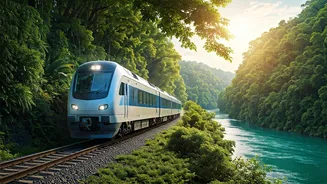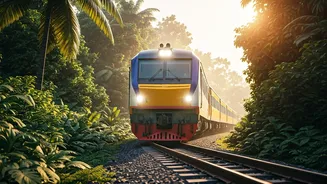









The Rise of the Green Track
For decades, the so-called ‘Banana Pancake Trail’ has been defined by budget flights and long bus rides. But a significant shift is underway. Spurred by a growing global consciousness around climate change and a post-pandemic desire for more meaningful
‘slow travel’, backpackers and tourists are increasingly looking to the rails. Southeast Asian nations are responding, investing heavily in upgrading their railway networks with a focus on sustainability. While the idea of a completely carbon-neutral network 'taking over' is still more of an ambition than a current reality, the momentum is undeniable. This isn't just about reducing emissions; it's about transforming the travel experience itself, making the journey as memorable as the destination.
Thailand’s Electric Railway Dreams
Thailand is at the forefront of this movement. The State Railway of Thailand (SRT) has been rolling out new electric and dual-mode locomotives, particularly on its popular northern line. The iconic overnight train from Bangkok to the lush mountains of Chiang Mai, a rite of passage for many travellers from India, is now a smoother, quieter, and cleaner experience. These new Chinese-made carriages offer modern comforts, from USB charging ports to pristine new berths. While the entire network isn't fossil-fuel-free yet, the introduction of electric-powered trains on key tourist arteries represents a major leap forward, significantly cutting down on the carbon footprint of one of the region's most beloved train journeys.
Vietnam's Reunification Ride Gets an Upgrade
The legendary Reunification Express, a 1,726-kilometre track connecting Hanoi and Ho Chi Minh City, is the steel backbone of Vietnam. This historic line, a symbol of national unity, is also seeing green shoots of change. While a full-scale electric overhaul is a long-term project, significant upgrades are enhancing efficiency and passenger comfort. Vietnam Railways has introduced new high-quality carriages on its most scenic stretches, like the breathtaking route from Da Nang to Hue over the Hai Van Pass. The focus here is on improving existing infrastructure to make train travel a more attractive and efficient alternative to domestic flights, thereby reducing the overall carbon emissions per passenger. It’s about making a classic journey more sustainable for the next generation of travellers.
Malaysia's Modern Rail Connection
Malaysia has been a regional leader in modern rail with its Electric Train Service (ETS). This high-speed network connects major destinations along the country's west coast, from the Thai border at Padang Besar down through Penang, Ipoh, Kuala Lumpur, and Gemas. For backpackers, this means you can travel almost the entire length of peninsular Malaysia quickly and with a much lower environmental impact than flying or taking a bus. The ETS is powered by electricity, making it one of the greenest ways to explore the country's diverse landscapes, from colonial-era towns to bustling metropolises. It seamlessly integrates into the regional trail, allowing for a smooth, low-carbon transition from Thailand into Malaysia.
What 'Carbon Neutral' Really Means
The term ‘carbon neutral’ can be tricky. In the context of Southeast Asian rail, it’s a mix of direct and indirect actions. The most impactful change is the switch to electric trains, like those in Malaysia and now appearing in Thailand. When powered by a grid that is increasingly incorporating renewable energy, these trains have near-zero direct emissions. However, in many cases, 'greener' travel also involves high-quality carbon offsetting. This means railway companies invest in environmental projects, such as reforestation or renewable energy development elsewhere, to compensate for the emissions their diesel trains still produce. While not a perfect solution, it's a vital transitional step that makes train travel a far more responsible choice than short-haul flights.