





Beyond the Goldilocks Zone
The concept of a habitable zone, an orbital band where temperatures are neither too hot nor too cold, has been a foundational guide for astronomers. If a planet is too close to its star, its oceans would boil away, like on Venus. If it's too far, they
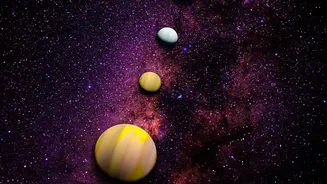
would freeze solid, like on Mars. This elegantly simple idea has served us well, helping to identify initial targets in the vastness of space. However, recent discoveries and more sophisticated models show that a planet’s address is only part of the story. An Earth-sized planet and a much larger 'super-Earth' in the exact same orbit could have wildly different climates. We are now realizing that two other factors are just as critical: the planet’s own size and the specific nature of the radiation blasting from its parent star.
Why Size Is a Big Deal
A planet's mass is a crucial factor in its ability to support life. A world that is too small, with a mass less than about 2.7% of Earth's, lacks the gravitational pull to hold onto a substantial atmosphere over billions of years. Without an atmosphere, there is no air pressure to keep water in a liquid state, no shield from harmful cosmic rays, and no way to regulate temperature. Mars is a prime example; scientists believe its small size led to its core cooling, its magnetic field shutting down, and its atmosphere being stripped away by the solar wind. On the other end of the spectrum, a planet that is too massive will tend to hold onto light gases like hydrogen and helium, evolving into a gas giant with no solid surface to stand on. The sweet spot lies with rocky worlds massive enough to power a protective magnetic field through a molten core and drive geological activity like plate tectonics, which helps regulate the climate.
A Star’s Double-Edged Sword
The energy from a host star is essential for life, providing the warmth and light needed for processes like photosynthesis. But this radiation is a double-edged sword. The same star that warms a planet can also destroy its chances of hosting life. Stars, especially younger and smaller ones like M-dwarfs, are known to be incredibly active, frequently unleashing powerful flares of X-ray and ultraviolet (XUV) radiation. This high-energy radiation can heat a planet's upper atmosphere to the point where it boils off into space, a process called photoevaporation. Over millions of years, this stellar stripping can erode an atmosphere entirely, rendering a planet sterile. Therefore, the type of star and its activity level are critical variables. A planet in the habitable zone of a calm, stable star has a much better chance of retaining its atmosphere than one orbiting a volatile, flare-prone star.
The Delicate Interplay
The most exciting frontier in habitability research is understanding how planet size and stellar radiation interact. A planet isn't just a passive recipient of its star's energy; its own properties determine its resilience. A larger rocky planet with a more substantial mass can generate a stronger, longer-lasting magnetic field. This magnetic shield can deflect the most harmful stellar winds and radiation, protecting the atmosphere from being stripped away. This means a more massive planet might be able to remain habitable even when orbiting closer to its star or enduring more intense radiation. In a breakthrough observation from 2026, scientists detected an atmosphere around the super-Earth LHS 1140 b, a rocky world orbiting a red dwarf star. Despite being blasted by X-rays, the planet's significant mass (5.6 times that of Earth) may have helped it retain its atmosphere for billions of years, a promising sign that some worlds can withstand even harsh stellar environments.