


For decades, industrial robots have been powerful but clumsy, excelling at repetitive tasks but failing at delicate ones. Now, companies like Eka Robotics are tackling the final frontier of automation: giving robots hands that can feel and adapt.
The Stubborn Challenge of the Robot Hand
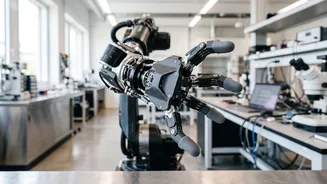
The human
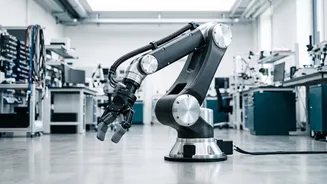
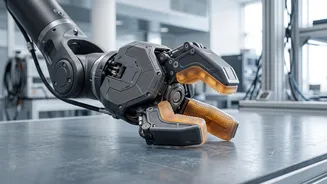
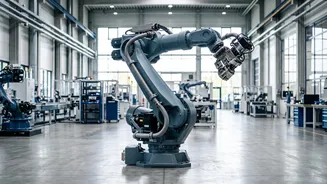
hand is a marvel of evolution, capable of everything from wielding a hammer to tying a shoelace. For robotics, replicating this dexterity has proven to be one of the most difficult and expensive challenges. While robotic arms are common in factories for tasks like welding and heavy lifting, their 'hands' are often simple grippers. These are great for moving predictable objects but struggle with anything that requires nuance, like picking a single piece of fruit from a pile, handling delicate electronics, or adjusting grip on a slippery item. This isn't just a mechanical problem; it's a sensory and software one. A robot needs to not only see an object but also feel it, understanding its shape, texture, and how much force to apply without crushing it. This gap between human touch and robotic capability is what has kept automation from taking over a vast number of manual jobs in manufacturing, logistics, and beyond.
Eka Robotics' Vision-Force-Action Approach
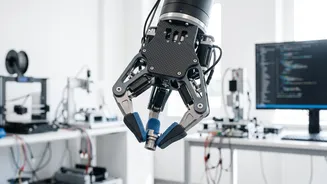
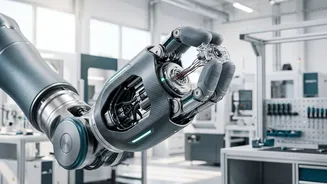
Enter Eka Robotics, a startup that recently attracted significant investment for its novel approach to this very problem. Instead of just relying on cameras, Eka is developing what it calls a 'Vision-Force-Action' (VFA) model. This system integrates three key elements: vision to locate the object, advanced force sensors in the gripper to 'feel' it, and an AI model that learns how to act based on both inputs. The breakthrough lies in treating physical contact as crucial information. When a robot using Eka's system begins to grasp an object, the force sensors provide real-time feedback. If the object starts to slip or if a connector isn't aligned perfectly, the AI can detect the change in forces and adjust its grip or angle instantly—much like a person would without thinking.
Training Smarter, Not Just Harder
Teaching a robot these skills is another area of innovation for Eka. Instead of relying solely on tedious and slow demonstrations by humans, the company heavily uses reinforcement learning in a physics simulator. This allows Eka to generate thousands of hours of robotic experience in just minutes, as the AI practices picking, turning, and inserting virtual objects over and over again. It learns from trial and error in this digital world, figuring out what works and what doesn't on a massive scale. This 'Real-to-Sim-to-Real' approach allows the AI to develop an intuition for physics that can then be transferred to the physical robot, enabling it to handle a wide variety of objects it has never seen before. In lab settings, Eka's robots have reportedly achieved pick rates of 1,500 objects per hour, more than double the average human speed of around 600.
The 'Real Work' Applications in India
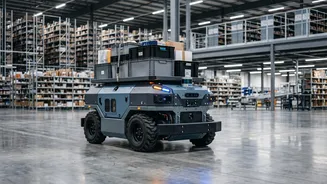
The phrase 'real work' refers to the countless non-standardized tasks that have so far resisted automation. In the context of India's growing manufacturing and e-commerce sectors, the implications are enormous. Think of a warehouse fulfillment center, where workers have to pick a huge variety of items—from soft clothing to rigid boxes—and place them in bins. A robot with dexterous, sensitive hands could automate this process, boosting efficiency and reducing errors. In India's booming electronics and automotive manufacturing hubs, such robots could handle the delicate assembly of small components, insert wires, or perform quality checks that require a light touch. This technology could also be applied in food processing for sorting and packing fragile produce, or in pharmaceuticals for handling vials and lab equipment.
The Road Ahead for Dexterous Robots
Despite the promise, the path to widespread adoption has hurdles. The primary challenge is moving from controlled lab demonstrations to the chaotic reality of a factory or warehouse floor, where robots must operate reliably for millions of cycles without failure. Durability and cost are also major factors; the custom-designed hands are complex, and bringing their production cost down is essential for mass adoption. However, the work being done by Eka Robotics and others in the field of AI-driven manipulation represents a pivotal moment. By focusing on the intricate problem of the robotic hand, they are not just building better grippers; they are aiming to unlock the next wave of automation, potentially transforming industries and redefining the nature of physical work for years to come.