





Cosmic Lighthouses in the Dark
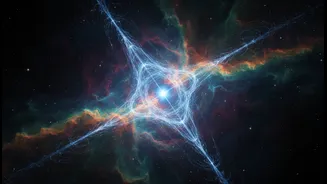
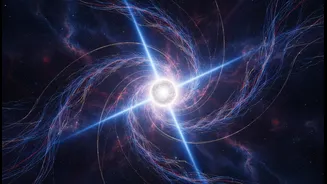
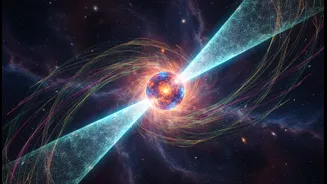
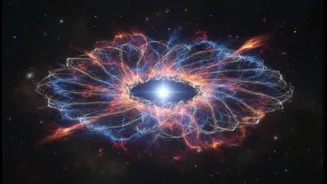
To understand the image, we first need to understand its subject: a pulsar. When a massive star runs out of fuel, it collapses under its own gravity and explodes in a spectacular supernova. What’s often left behind is a super-dense, city-sized object
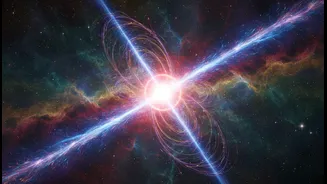
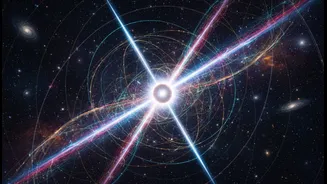
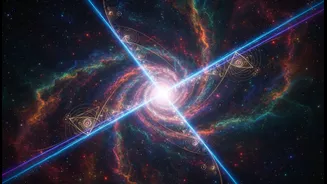
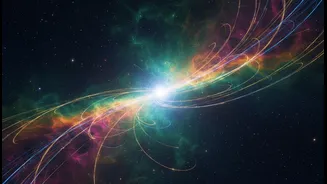
called a neutron star. Some of these neutron stars spin incredibly fast, hundreds of times per second, sweeping beams of electromagnetic radiation across space from their magnetic poles. If one of these beams happens to point toward Earth as the star rotates, we see a regular pulse of energy—much like the beam from a lighthouse. This is a pulsar. The one in question, PSR J1101−6101, is the engine powering the magnificent structure astronomers are now studying in detail.
The Beautiful Chaos of a Pulsar Wind
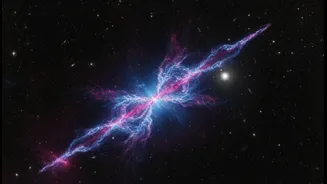
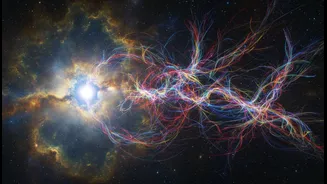
Pulsars don't just sit there flashing. Their intense, rapidly rotating magnetic fields are powerful enough to rip charged particles from their surface and accelerate them to nearly the speed of light. This outflow of particles is known as a pulsar wind. This isn't a gentle breeze; it's a torrent of plasma that crashes into the surrounding gas and dust left over from the supernova. This collision creates a beautiful, glowing structure called a pulsar wind nebula. These nebulae are cosmic laboratories where scientists can study how particles are accelerated to extreme energies. For years, however, the exact shape and behaviour of these nebulae have been puzzling. The Lighthouse Nebula, for instance, has a long, filament-like structure that seemed to defy simple explanation.
A New Map Reveals the Hidden Skeleton
For nearly two decades, astronomers theorised that the needle-thin shape of the Lighthouse Nebula was formed by particles escaping the pulsar and flowing along the galaxy's own magnetic field lines. But proving it was difficult because the nebula is incredibly faint in X-rays. Recently, scientists used NASA's Imaging X-ray Polarimetry Explorer (IXPE) to do something new: measure the polarisation of the X-ray light. Think of light waves as vibrating in various directions; polarisation measures the dominant direction of that vibration. This, in turn, reveals the direction of the magnetic field that produced the light. After observing the nebula for nearly 18 days in June 2025, IXPE gathered enough data to create the first-ever magnetic field map of this structure.
Solving an Astronomical Puzzle
The results from IXPE were a stunning confirmation of the long-held theory. With more than 99% confidence, the team confirmed that the magnetic field perfectly aligns with the long filament of the nebula. This alignment is the 'smoking gun' proving that the pulsar's wind is indeed being channelled by the galactic magnetic field, creating the nebula's distinctive shape. But the map also delivered a surprise. The degree of polarisation was unexpectedly high, which suggests the magnetic field is far more orderly and less turbulent than many models had predicted. This discovery challenges existing theories about how pulsar winds behave and forces a rethink of the physics at play in these extreme environments. It shows that particles of different energies might be created through completely different mechanisms within the same system.