








What is an Optical Skyrmion?
First conceptualized in nuclear physics in the 1960s, a skyrmion is a stable, particle-like knot in a field. Think of it like a self-contained whirlpool that holds its shape even when disturbed. For decades, they were studied primarily in magnetic materials.
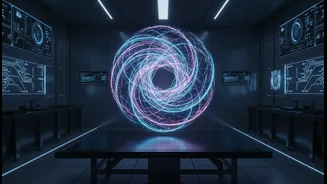
Only in the last several years have scientists managed to create and observe their equivalent in light, giving birth to the 'optical skyrmion'. These are incredibly small, stable, swirling patterns formed within the properties of a light field, such as its polarization and phase. Imagine sculpting light itself into a nanoscale knot that doesn't easily come undone, and you have the basic idea. This topological stability is what makes them so interesting; unlike a simple flicker of light, a skyrmion has a robust structure that can, in theory, be used to represent information.
The Transformative Promise
The excitement around optical skyrmions stems from their potential to overcome the limitations of current electronics. As we push transistors to their physical limits, heat and energy consumption become major problems. Photonics—using light instead of electrons—is a promising alternative. Optical skyrmions could serve as the bits in a new generation of light-based computing and data storage. Because they are incredibly small and stable, they could lead to ultra-high-density data storage. Their ability to be manipulated with light suggests faster processing speeds and lower power consumption compared to their electronic counterparts. Beyond computing, potential applications are being explored in high-resolution imaging that could bypass traditional diffraction limits, as well as in secure quantum communications where their topological protection could prevent data from being easily disturbed.
The Experimental Reality Check
This is where the headline's caution comes into play. The field of optical skyrmions is extremely new, with the first experimental demonstrations occurring only around 2018. For now, this is a realm of pure laboratory science. A major challenge is simply creating and controlling them. Early methods relied on complex setups involving engineered 'metamaterials' or plasmonic effects on metal surfaces, which are difficult and expensive to work with. While recent breakthroughs have found simpler methods, such as shining a laser at a tiny disc, controlling the skyrmions' behaviour over distances remains a significant hurdle. The equipment needed is highly specialized, and researchers are still working to understand the fundamental interactions between these light structures and different materials. Transferring a skyrmion's topological information from light to matter—a key step for any storage application—has only recently been demonstrated and is not yet perfected.
From Lab Curiosity to Commercial Tech
The journey from a scientific curiosity to a viable technology is long and uncertain. For optical skyrmions, the path forward involves several key steps. Researchers are focused on developing more robust and efficient ways to generate and, crucially, manipulate them on demand. This includes controlling their size, shape, and how they move and interact. Another critical area is developing effective detectors; creating a topological light structure is one thing, but reading the information it carries is another challenge entirely. Furthermore, much of the research is currently theoretical or confined to highly controlled, pristine laboratory conditions. Scientists need to explore how these delicate structures behave in more complex, 'noisy' environments that better reflect the real world before they can be integrated into practical devices. While the research is advancing rapidly, with new discoveries being published regularly, commercial application is likely still a decade or more away.