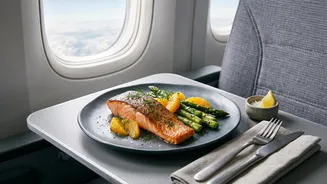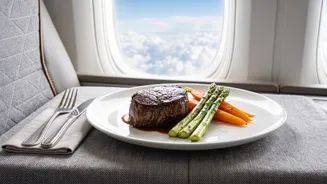









We’ve all been there: the meal cart rolls down the aisle, and the foil is peeled back to reveal a meal that looks passable but tastes strangely bland. Before you blame the chef, know this: it’s not the food, it’s the flight.
It's Not the Heat, It's the Humidity
The first and most powerful
culprit behind bland airplane food is not the pressure, but the profound lack of humidity. At a cruising altitude of 35,000 feet, the air pumped into the cabin is exceptionally dry, with humidity levels often dropping below 12%, which is drier than most deserts. Our sense of smell is responsible for about 80% of what we perceive as flavour. To function correctly, the olfactory receptors in our nose need moisture. In a bone-dry cabin, your nasal passages dry out, significantly reducing your ability to detect the aromatic compounds that give food its complex flavour. Before the plane even takes off, the controlled atmosphere inside begins this process, and it only intensifies at altitude. A perfectly seasoned dish on the ground can lose much of its character before it even reaches your tray table, simply because your nose is no longer able to pick up its scent.
Your Senses Under Pressure
While the headline points to pressurised air, the issue is more accurately lowered pressure. Even in a pressurised cabin, the atmosphere is equivalent to being at an altitude of 6,000 to 8,000 feet. This drop in pressure, combined with slightly lower blood oxygen levels, has a direct impact on your taste buds. Research commissioned by German airline Lufthansa at the Fraunhofer Institute for Building Physics confirmed this in a simulated cabin environment. The study found that our perception of salty and sweet flavours drops by as much as 20–30% at altitude. Your taste buds for these specific flavours become less sensitive, meaning a meal needs significantly more salt or sugar in the air to taste the same as it would on the ground. However, not all tastes are affected equally. Sour, bitter, and spicy flavours remain relatively stable.
The Surprising Role of Sound
Perhaps the most unexpected factor in this sensory puzzle is the constant drone of the jet engines. The loud, persistent background noise, often reaching 85 decibels or more, isn't just a minor annoyance; it actively changes your perception of taste. Studies have shown that this type of loud white noise suppresses the brain's ability to register sweet tastes. This phenomenon, sometimes called 'sonic seasoning', is believed to be linked to how your brain allocates its attention, drawing focus away from the subtleties of flavour. Interestingly, this effect is not universal across all tastes. The same research discovered that while engine noise dulls sweetness, it can actually enhance the perception of umami—the fifth taste, responsible for savoury, rich, and brothy flavours. This neurological quirk helps explain why so many people crave a Bloody Mary or a simple tomato juice on a flight; the umami-rich tomato flavour is one of the few that punches through the dulling effects of the cabin environment.
How Airlines Engineer Flavour at 35,000 Feet
Airline caterers are not oblivious to this multi-sensory challenge; they are food scientists battling physics. Knowing that salt and sugar are muted, they can't simply add more, as that would lead to unhealthy and dehydrating meals. Instead, they engineer menus to work with, not against, the in-flight environment. This means focusing on ingredients that are naturally rich in umami, which remains stable or is even enhanced by cabin conditions. You'll find menus featuring mushrooms, soy sauce, aged cheeses like Parmesan, and tomato-based sauces. Spices and acidic notes are also used more liberally, as their perception is less affected by altitude and dryness. So next time you're served a curry or a pasta with a robust tomato sauce, know that it was likely chosen because its flavour profile is resilient enough to withstand the journey from the ground to your high-altitude palate.