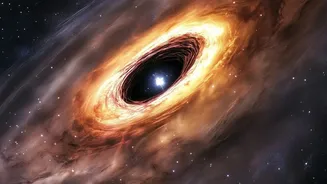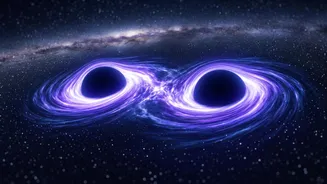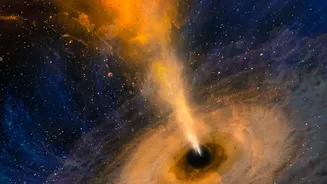



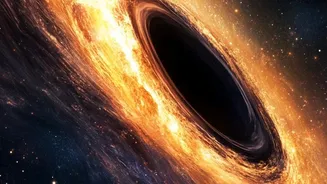

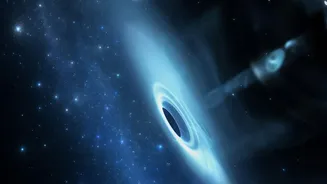
We think of black holes as cosmic vacuum cleaners that only ever merge and grow. But what if they could do the opposite? Physicists are now exploring the mind-bending possibility that, under very specific conditions, one black hole could split in two.
Challenging a Cosmic Rule
For decades, the rules of the universe seemed clear: black holes merge, they don't divide. This was based on fundamental principles of physics, particularly thermodynamics. A key concept is entropy, a measure of disorder in a system. For a non-rotating black hole, splitting into two smaller ones would decrease the total entropy, which is like unscrambling an egg—a process that is thermodynamically forbidden. This principle, known as Hawking's area theorem in a classical context, essentially states that the surface area of a black hole's event horizon—and thus its entropy—can never decrease. This has long been considered a fundamental barrier to a black hole ever breaking apart.
The Loophole of Extreme Spin
However, a new theoretical study published in the journal Physical Review D suggests a loophole. An international team of physicists investigated what happens when you push a black hole to its absolute limit. Their calculations indicate that if a black hole is rotating at, or very near, its maximum possible speed, the rules might change. This extreme rotation alters the thermodynamic calculation. A rapidly spinning black hole has less entropy to begin with than a stationary one of the same mass, creating a scenario where a split could occur without violating the law of increasing entropy. This theoretical split would cause the event horizon to deform into a shape the researchers have amusingly dubbed a 'pair-of-pants topology', where one 'leg' represents each of the new, smaller black holes.
More Than Just a Fast Spin
Even with extreme rotation, a split is far from guaranteed. Another major hurdle is ensuring the two newly formed black holes can actually escape each other. If they don't separate quickly and with enough energy, their immense gravitational pull would simply cause them to merge back together almost instantly. The researchers found that this requirement closes the window for a split almost entirely, except for black holes spinning at the very edge of their physical limits. The study also explored more exotic possibilities, such as theories involving extra dimensions of space. In these models, black-hole-like objects could become unstable and break apart more easily.
Searching for Cosmic Crumbs
This is all fascinating theory, but is there any way to prove it? As of now, no such event has ever been observed. The researchers stress that they cannot yet assign a probability to a black hole splitting, as it depends on how gravity behaves beyond Einstein's currently accepted theory. However, they propose an indirect method for finding evidence. The theory suggests that smaller, primordial black holes, hypothetical objects formed in the early universe, might be more prone to splitting. If these splits happen, they could produce tiny fragments that evaporate, releasing detectable signals in the form of gamma rays. Telescopes like NASA's Fermi-LAT could potentially search for these specific energy signatures, offering a way to test the idea.