








The Universe’s Missing Ingredient
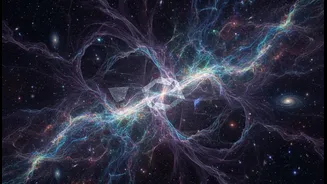
For nearly a century, scientists have been grappling with a cosmic puzzle: galaxies are spinning so fast they should fly apart. The visible matter we can detect doesn't have nearly enough gravity to hold them together. To account for this, physicists
proposed the existence of “dark matter,” an invisible substance that doesn’t interact with light but exerts a powerful gravitational pull. It is the invisible scaffolding of the cosmos, making up about 85% of all matter. While we are certain it exists, we have never directly observed it, and its true nature remains one of the biggest unanswered questions in all of science.
Enter the Fifth Dimension
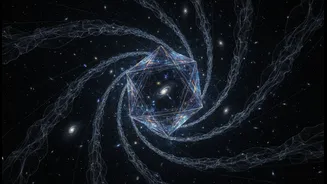
The standard model of particle physics, our best description of the fundamental particles and forces, has no room for a dark matter candidate. This has forced scientists to think outside the box—or in this case, outside our familiar dimensions. A recent theory from physicists at the University of Sheffield proposes that dark matter might reside in a hidden fifth dimension. The idea of extra dimensions isn't new; theories like string theory have predicted their existence for decades. Most models imagine these dimensions are curled up incredibly tightly, too small for us to perceive. This new theory, however, builds on models of a "warped extra dimension" to create a compelling new explanation for dark matter.
A Cosmic Resonance
The Sheffield theory suggests that particles of dark matter exist in this fifth dimension alongside a hypothetical particle known as a “dark photon.” According to the researchers, the specific geometry of this hidden dimension naturally causes the masses of these particles to align in a precise way. This creates a phenomenon they call a “dark matter resonance,” which can be loosely compared to how a guitar string vibrates powerfully when it hits the perfect note. This resonance would have allowed dark matter to interact strongly in the early universe but makes it almost undetectable today, potentially explaining why our decades-long search has come up empty.
Why This Matters for Everyone
This all might sound like abstract science fiction, but the implications of solving the dark matter mystery are enormous. History shows that breakthroughs in fundamental physics eventually lead to revolutionary technologies. The study of electromagnetism in the 19th century gave us everything from radio to computers and the internet. The exploration of quantum mechanics paved the way for lasers, MRI machines, and modern electronics. Understanding dark matter isn't just about filling a gap in our cosmological models; it's about pushing the boundaries of what's possible. The ultra-sensitive detectors and advanced technologies developed in the hunt for dark matter have already found applications in medicine and computing.
Redefining Reality and Our Future
Confirming the existence of a fifth dimension would fundamentally alter our perception of reality. It would prove that the universe is far richer and more complex than our senses tell us. If we could one day learn to access or manipulate extra dimensions, it could open up technological avenues straight out of science fiction, such as new forms of energy or even shortcuts through spacetime. While such applications are highly speculative, they highlight the transformative potential of this research. The quest to understand dark matter forces us to confront the biggest questions about the universe: what it's made of, how it began, and where it's going. Solving it would be a profound leap in human knowledge, on par with the discoveries of Copernicus or Einstein.