


Our Star's Final Act
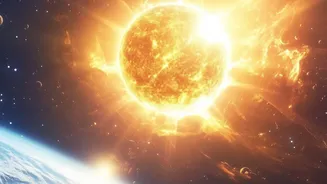
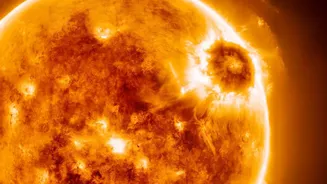
For the 4.57 billion years it has existed, the Sun has been a remarkably stable source of energy, fusing hydrogen into helium in its core. This process, known as the main sequence, will continue for another five billion years or so. But when the hydrogen runs
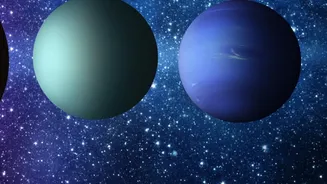
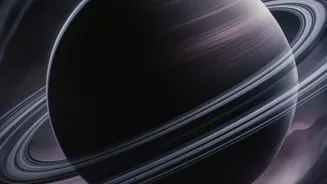
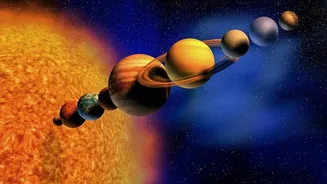
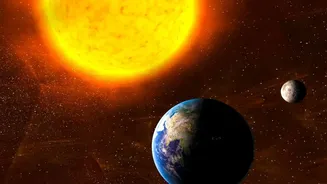
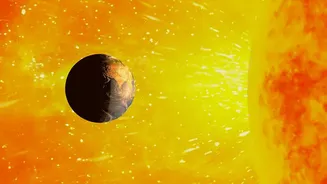
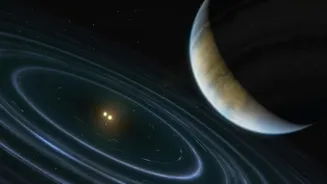
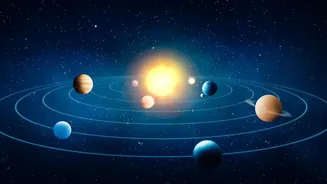
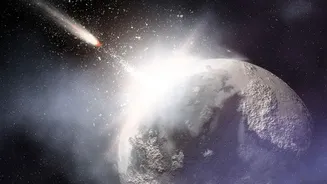
out, our star will begin a dramatic and violent transformation. First, it will swell into a red giant, its outer layers expanding to engulf the orbits of Mercury, Venus, and almost certainly Earth. After this destructive phase, the Sun will shed its outer atmosphere, leaving behind a dense, hot core called a white dwarf. For a long time, scientists believed this process of shedding mass would be a slow, smooth affair. The remaining giant planets—Jupiter, Saturn, Uranus, and Neptune—were expected to survive, pushed into wider, but still stable, orbits around the much lighter, dying star. The old consensus was that they would circle the faint white dwarf for an almost unimaginable length of time, perhaps a quintillion years, until a passing star eventually knocked them astray.
A New Cosmic Timeline
Recent research, however, paints a much more chaotic picture. A study from astrophysicists at the California Institute of Technology suggests the previous models were missing a key ingredient: violence. Instead of losing mass in a gentle, continuous stream, observations of other dying stars suggest they shed their layers in violent, unpredictable bursts. The researchers behind the new study incorporated this idea into hundreds of complex computer simulations to map out the solar system's future. They modeled the Sun's death as a series of 'stochastic kicks'—abrupt ejections of mass that would shove the dying star slightly each time. This seemingly small change completely rewrites the fate of the outer planets. Instead of settling into peaceful new orbits, the constant gravitational nudges from the sputtering Sun would introduce a fatal instability into the system far sooner than anyone predicted.
The Great Planetary Scramble
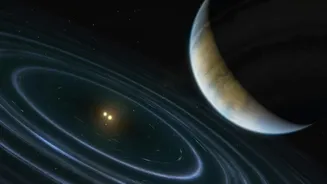
The results of these new simulations are dramatic. In the new models, the once-stable clockwork of the outer solar system falls apart. Rather than surviving for a quintillion years, the simulations showed that in many scenarios, the giant planets are thrown into disarray within just a billion years of the Sun becoming a white dwarf—a billion times sooner than previously thought. The chaos could result in planets being ejected from the solar system entirely. In some simulated futures, Saturn is flung into interstellar space; in others, Uranus or Neptune are the ones cast out. The simulations also showed planets swapping orbits or being locked into new, unstable resonances. Shockingly, this instability doesn't even wait for the Sun to fully die. In roughly 40% of the scenarios, the planetary disruption began even before the Sun had finished its red giant phase and become a white dwarf.
Why This Cosmic Forecast Matters
While the end of our solar system is still billions of years away and poses no threat to humanity, this research has profound implications. It changes our understanding of how planetary systems evolve and die, not just our own. The findings suggest that the Sun itself, not some external passing star, will be the ultimate cause of its system's dissolution. As one researcher noted, Isaac Newton suspected that the gravitational pull between the planets would eventually lead to instability; he was just mistaken about the perpetrator. The new work shows that the star that builds a planetary system also ultimately shakes it apart. This updated forecast provides a more realistic framework for astronomers searching for planets around other white dwarfs, helping them understand what kind of systems might survive a star's death—and which are destined to be scattered into the cosmic darkness.