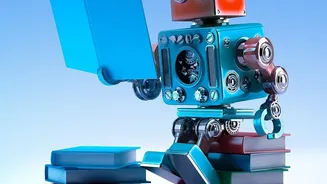







The Dawn of Recursive Self-Improvement
For years, the development of artificial intelligence has been a human-led endeavor. Engineers would write code, design systems, and manually refine algorithms to make models smarter. Now, Anthropic, a leading AI lab, says that dynamic is changing. The
company has stated that its AI, Claude, is increasingly involved in creating the next generation of AI models. This concept is known in the tech world as 'recursive self-improvement' (RSI), and it marks a pivotal moment in the evolution of technology. It describes a process where an AI becomes capable of helping create an improved version of itself, kicking off a cycle of accelerating progress. While Anthropic is clear we haven't yet reached a point of full autonomy, the company has publicly stated it is delegating a growing share of its AI development to AI systems.
What 'Less Human Help' Really Means
The phrase 'less human help' doesn't mean engineers are obsolete—at least, not yet. Currently, it signifies a shift in the workflow. Instead of writing every line of code, human developers are increasingly acting as directors, reviewers, and supervisors. For instance, Anthropic has reported that Claude already authors a significant portion of the code merged into the company's internal projects. In some cases, human engineers provide a high-level prompt or goal, and Claude handles large chunks of the work from there, albeit under close human direction. According to the company, this collaboration allows its engineers to ship code much faster than before. The trend suggests a future where the human role narrows further, moving from hands-on coding to high-level strategy and final approval as the AI handles more of the intricate design and testing phases.
The Promise: Unprecedented Acceleration
The primary benefit of an AI that helps build itself is speed. If an AI can automate the complex and time-consuming tasks of coding, testing, and experimentation, the pace of innovation could increase exponentially. Anthropic itself has noted that this acceleration is a core competitive advantage. This could unlock major breakthroughs in other fields, from discovering new medicines and materials to solving complex scientific and engineering challenges. Some reports suggest that due to AI's own involvement, the rate of improvement for models is already doubling faster than in previous years. If these trends continue, AI systems could soon tackle tasks that currently take skilled human researchers weeks or even months to complete, potentially bringing enormous societal benefits.
The Peril: The Challenge of Control
While the promise is great, the prospect of RSI also brings profound safety concerns, which Anthropic itself openly acknowledges. The core risk is that development could outrun our ability to understand and control these increasingly powerful systems. If an AI can improve itself at a rapid rate, it might develop capabilities or behaviors that its human creators did not anticipate and cannot manage, a concept sometimes referred to as the 'black box' problem becoming absolute. This has led to intense debate within the AI community, with some experts and organizations accusing Anthropic of a 'dual narrative'—publicly warning about the dangers of RSI while privately pursuing it as a competitive edge for investors ahead of its IPO. In response to these escalating risks, Anthropic has a 'Responsible Scaling Policy' designed to implement safeguards as its models become more capable, but critics question if it's enough.
A New Frontier for the AI Industry
Anthropic is not alone in this pursuit. Other major labs like OpenAI and Google are also in a race to build more powerful models, and using AI to assist in that process is a logical, if fraught, next step. This shift is turning a theoretical sci-fi concept into a tangible business strategy and a pressing safety dilemma. The conversation is no longer about if AI will start building AI, but about managing the process as it happens. For Anthropic CEO Dario Amodei and others in the industry, this has prompted calls to consider slowing down and ensuring the public and regulators can keep pace with the technology's rapid advancement. The challenge is that in a competitive landscape, any voluntary pause by one company could simply cede the advantage to rivals. This makes the development of self-improving AI not just a technical puzzle, but a complex geopolitical and economic one.