






Why Sitting Is the New Smoking
You’ve likely heard the phrase, and while it sounds dramatic, there's a core of truth to it. A sedentary lifestyle, where you spend most of your day sitting, is linked to a host of health issues. Research shows that spending ten or more hours a day sitting increases
the risk for cardiovascular problems, even if you exercise regularly. Prolonged sitting can lead to slower metabolism, muscle weakness, weight gain, and poor posture. It causes hip flexor muscles to shorten and tighten, leading to hip and back problems. It can also affect your mental well-being, with studies showing a link between sedentary behaviour and an increased risk of anxiety and depression. The good news is that you can counteract these effects with small, consistent actions. Taking regular breaks to stand and move can make a significant difference.
Your 2-Minute Reset Routine
This simple sequence is designed to be done right at your desk, targeting the key areas that suffer most from sitting. You don't need any special equipment. The goal is a gentle stretch, so never force a movement to the point of pain. Perform each stretch for about 30 seconds to fit within a two-minute window. Set a reminder on your phone and give your body this much-needed break.
Neck and Shoulder Release
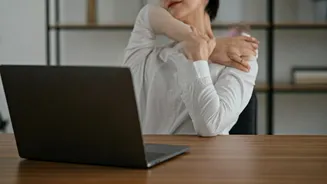
Let's start by releasing the tension that builds up from staring at a screen. Sit tall in your chair with your feet flat on the floor. First, perform a gentle neck roll by slowly lowering your chin to your chest, then rolling your right ear toward your right shoulder, back to the center, and then your left ear toward your left shoulder. After a few rolls, return to a neutral position. Next, tackle the shoulders. Roll your shoulders backward in big circles, squeezing your shoulder blades together. Then, interlace your fingers behind your back, push your chest out, and lift your arms until you feel a stretch across your chest. This helps counteract the classic desk-worker slump.
Spinal Twist and Back Extension
Your spine spends hours in a hunched position, so this stretch helps restore mobility. While seated, twist your torso to the right, using your chair's armrest for a gentle pull. Hold for 15-20 seconds, feeling the stretch through your back, then repeat on the left side. Next, perform a simple back extension. You can do this by placing your hands on the small of your back and gently arching backward, lifting your chest. Alternatively, if your chair is sturdy, you can lean back over the top of it, letting your upper back extend while keeping your elbows wide. This simple move provides immediate relief to a compressed spine.
Hip and Leg Awakener
Sitting for long periods can make your hips tight and your leg muscles inactive. To counter this, perform a seated hip stretch. Cross your right ankle over your left knee. Sit up straight and gently lean forward, pressing down lightly on your right knee if you want a deeper stretch. You'll feel this in your right glute and hip. Hold for about 15 seconds, then switch sides. Finally, wake up your hamstrings. While sitting, extend one leg straight out in front of you with your heel on the floor. Gently lean forward until you feel a stretch in the back of your leg. Hold, then repeat with the other leg.