



What Exactly Is a 'Planet Cluster'?
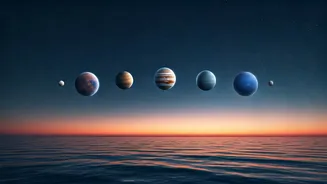
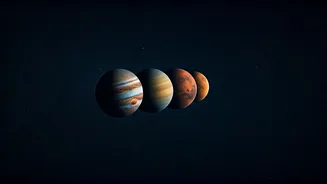
First, let's clarify what we're seeing. The term 'planet cluster' paints a dramatic picture, but the planets aren't actually close to each other in space. Instead, from our vantage point here on Earth, their orbits are bringing them into the same small
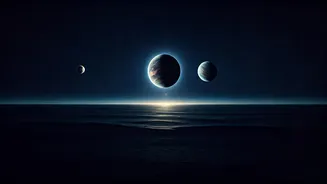
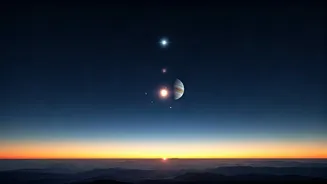
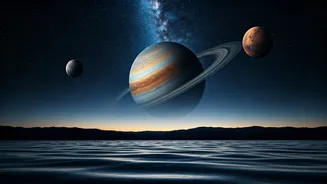
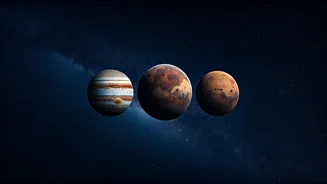
patch of our night sky. Astronomers call this a conjunction or an alignment. It’s a beautiful line-of-sight illusion that makes it seem as though Mars, Venus, and Saturn are huddled together. Venus, the brightest of the trio, will appear as a brilliant, unblinking star. Saturn will be fainter and slightly yellowish, while Mars will be identifiable by its distinct reddish hue. Seeing three planets at once without a telescope is a special treat because it allows you to easily compare their brightness and colour in a single glance.
Your Viewing Guide: When and Where to Look
Timing and location are everything for successful skywatching. For viewers in India, this planetary trio will be visible in the pre-dawn sky. The best time to look is approximately 45 to 60 minutes before sunrise. You’ll want to find a spot with a clear, unobstructed view of the eastern horizon. This means getting away from tall buildings, trees, and, most importantly, city lights. Light pollution is the biggest enemy of stargazing, as it washes out fainter objects. So, if you can, head to a terrace, a park, or the outskirts of your city. You don’t need to know the exact compass direction; just look towards where the sun will rise. The planets will be a noticeable grouping of 'stars' that don't twinkle as much as actual stars do.
Naked Eye, Binoculars, or Telescope?
The great news is that this event is accessible to everyone. With just your naked eyes, you will easily spot the three planets as bright points of light. Venus will be impossible to miss. Your challenge will be to distinguish the fainter Mars and Saturn nearby.If you have a pair of binoculars, the view gets even better. Binoculars will make the colours of Mars and Saturn much more apparent. They gather more light, making the planets pop against the twilight sky. You won't see surface details, but the experience becomes richer.A small telescope, however, is where the magic truly happens. A basic telescope will transform Saturn from a dot of light into a tiny, perfect sphere encircled by its glorious rings. It's a sight that never fails to amaze. You might also be able to resolve Mars as a tiny reddish disc rather than a point of light. Even a modest instrument can bring the solar system to your doorstep.
What Makes This Alignment 'Epic'?
While planetary conjunctions are not extraordinarily rare, a gathering of three bright planets in such a tight formation is certainly special. The 'epic' nature of this event isn't about any cosmic danger; it's about its beauty and convenience. It’s a fantastic opportunity for aspiring astronomers and photographers. For anyone trying to learn the night sky, having three major planets bundled together serves as a perfect celestial landmark. You can identify them all in one go and get a real sense of the solar system in motion. These alignments remind us that we are on a moving planet in a dynamic system of orbiting worlds—a cosmic dance that we get to witness from our own backyard.