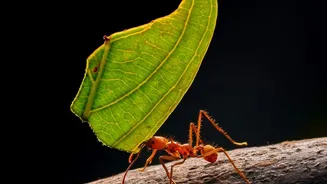



Long before humans ever planted the first seed, another society had already mastered the art of agriculture. Meet the leafcutter ant, an insect that doesn't eat the leaves it diligently carries, but uses them to farm its own food.
Nature's Tiny Farmers
Across the tropical forests
of the Americas, millions of tiny gardeners are hard at work. These are the leafcutter ants, belonging to the genera Atta and Acromyrmex. They are famous for marching in long, determined lines, each ant holding a piece of a green leaf high above its head like a banner. But here’s the fascinating twist: they don't actually eat these leaves. Instead, they are master farmers, and the leaves are not the meal but the fertilizer for their unique crop. Next to humans, leafcutter ants form some of the most complex animal societies on Earth, with some underground nests growing to incredible sizes, housing millions of individuals. Their entire civilization is built around a single, extraordinary activity: cultivating a special fungus that serves as their sole source of food.
The Underground Garden
The journey of a leaf fragment is a masterclass in biological engineering. Once a foraging ant snips a piece of a leaf, it carries it back to the colony's vast underground nest. There, the leaf isn’t just piled up; it’s handed over to smaller worker ants who begin a meticulous process. They first clean the leaf surfaces, scraping them to remove any potentially harmful microbes or rival fungal spores. Then, they chew the leaf into a damp pulp, mixing it with their own saliva and fecal matter, which contain enzymes that help break down the tough plant material. This processed mulch is then carefully integrated into the existing fungus garden. Finally, a worker ant 'plants' the new material by adding a small piece of the existing fungus, Leucoagaricus gongylophorus, to the fresh pulp, ensuring the crop continues to grow.
A Perfect Partnership
This relationship between the ants and the fungus is a textbook example of obligate mutualism—neither can survive without the other. The ants cannot digest the tough cellulose in leaves themselves, so they rely completely on the fungus to break it down. In return for this service, the fungus produces specialized, nutrient-rich structures called gongylidia. These swollen, white tips are packed with the proteins, lipids, and sugars that feed the entire ant colony, especially the queen and her developing larvae. The fungus, for its part, has become so domesticated over millions of years that it no longer produces spores to reproduce in the wild; it relies entirely on the ants for propagation. When a new queen leaves to start her own colony, she carries a small piece of the precious fungus in a special pocket in her mouth to seed her new garden.
A Society Built on Farming
This agricultural lifestyle has shaped every aspect of leafcutter ant society, leading to a highly specialized caste system. The colony is divided into different-sized workers, each with a specific job. The largest ants, the 'majors' or soldiers, defend the nest from intruders. The 'mediae' are the primary foragers, cutting and transporting the bulk of the leaves. Smaller still are the 'minors,' who often patrol the foraging trails. The smallest ants, the 'minims,' never leave the nest. They are the dedicated gardeners, tending to the fungus, processing new leaves, and caring for the queen and the brood. This division of labour ensures the farming operation runs with incredible efficiency, from harvesting to cultivation and defence.
Fighting Pests and Disease
Like any farmer, leafcutter ants must constantly battle pests and diseases that threaten their crop. Their biggest enemy is a parasitic fungus called Escovopsis, which can devastate a garden if left unchecked. To combat this, the ants have developed a sophisticated, multi-layered defence system. They meticulously groom their gardens, removing any infected sections and carrying them to special underground waste chambers to prevent contamination. Even more remarkably, the ants have a third symbiotic partner in this fight. They carry colonies of bacteria, often from the genus Pseudonocardia, on their own bodies. These bacteria produce potent antibiotics that specifically inhibit the growth of the parasitic Escovopsis mold, while leaving their food fungus unharmed. It is a form of natural pest control that predates human use of antibiotics by millions of years.