



Your First Step: Just Look Up
The best way to start your stargazing journey is with the simplest tool you have: your own eyes. You don't need a telescope to appreciate the night sky. Find a spot away from the glare of city lights—a backyard, a local park, or even a balcony can work.
Give your eyes about 20-30 minutes to fully adjust to the darkness. During this time, avoid looking at your phone screen, as its bright light will reset your night vision. You'll be amazed at how many more stars become visible as your eyes adapt. This simple act of patience is the foundation of all observational astronomy.
Your Digital Guide: Stargazing Apps
While your eyes are the main tool, your smartphone can be an invaluable guide. There are many user-friendly astronomy apps that use your phone's location and sensors to create a real-time map of the sky. Just point your phone upwards, and the app will identify the stars, constellations, and planets you're seeing. It takes the guesswork out of figuring out whether that bright light is a planet or just a distant airplane. Many apps also provide details about celestial objects and notify you of upcoming events like meteor showers or satellite passes. Think of it as a pocket planetarium.
October's Planetary Highlights
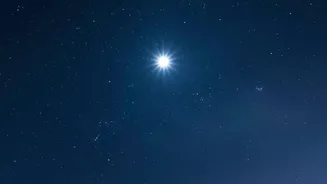
This October is a fantastic month for planet-spotting. The star of the show is Saturn, which reaches opposition on October 4. This means Earth is passing directly between the sun and Saturn, making the ringed planet appear at its biggest and brightest for the year, visible all night long. While you'll need a telescope to see its famous rings, Saturn will be unmistakable to the naked eye as a bright, steady, golden point of light. Mars and Jupiter will be visible in the early morning sky. On October 11, Mars will pass through the Beehive Cluster, a sight easily enjoyed with binoculars.
Constellations to Find This Month
October's evening sky features some of the most recognisable constellations for Northern Hemisphere observers. Look for the Great Square of Pegasus, a large, easy-to-spot box of four stars that serves as a celestial landmark for the autumn sky. From there, you can trace your way to other patterns. Nearby is Cassiopeia, which looks like a distinct 'W' or 'M' depending on its orientation. The faint constellation Aquarius is also well-placed for viewing. Using an app will help you connect the dots and see the shapes that ancient observers imagined in the sky.
Catch a Falling Star: Two Meteor Showers
October hosts two meteor showers. First are the Draconids, peaking on the evening of October 8-9. Unlike most showers, the Draconids are best viewed in the early evening, right after nightfall. This is a minor shower, typically producing around 10 meteors per hour, but viewing conditions are excellent in 2026 with no bright moonlight to interfere. Later in the month, look for the Orionids, which peak on the nights of October 21-22. These meteors are debris from the famous Halley's Comet and can produce up to 20 fast, bright meteors per hour. The best time to watch will be in the hours before dawn, after the moon sets.
The Next Step: A Pair of Binoculars
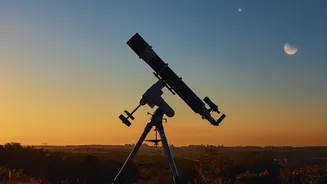
If you find yourself captivated and want to see more, your next step isn't a complex telescope—it's a simple pair of binoculars. Even a standard pair will reveal stunning details you can't see with the naked eye. You'll be able to explore the craters of the Moon, see the four largest moons of Jupiter appearing as tiny dots of light, and get a much better view of star clusters like the Pleiades or the Beehive. Binoculars offer a wide field of view, making it easier to scan the sky and find objects without getting lost, which is a common frustration for telescope beginners.